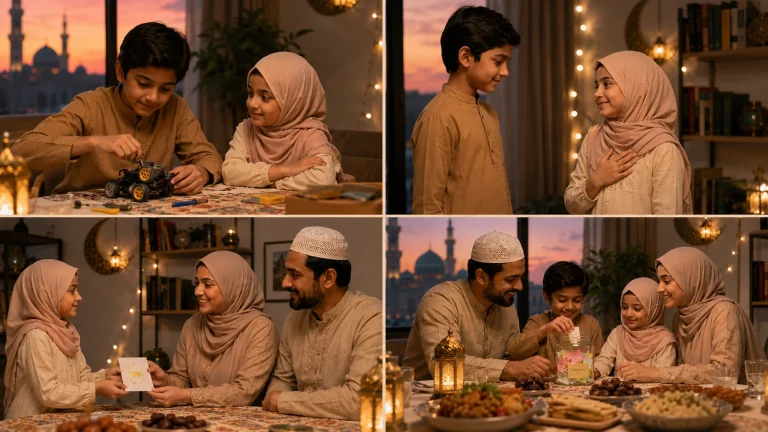
A Family Forgiveness Jar is a simple Ramadan activity for kids during the 2nd Ashrah. Each family member writes a note about someone they forgive, a mistake they want to fix, or a kind deed they did, then places it in a jar. It helps children learn tawbah, Allah’s mercy, and making amends.
New to this topic? Start with our full guide on helping kids ask for forgiveness (Maghfirah) during Ramadan.
Pair this activity with our guide on teaching Nijat to kids gently to talk about Allah’s protection alongside His forgiveness.
Want the exact words to say each night? Here is the Second Ashrah Dua Ramadan – Days of Forgiveness.
On This Page
The 2nd Ashrah: Ramadan’s Forgiveness Days
Ramadan comes in three parts of ten days each. We call each part an Ashrah.
The Prophet Muhammad ﷺ said:
“Whoever fasts Ramadan out of sincere faith and hoping for reward from Allah, his previous sins will be forgiven.”
(Sahih al-Bukhari 38)
So the second Ashrah — days eleven to twenty — is the season of forgiveness. Maghfirah.
This is when the heart slows down and asks a quiet question.
Who do I need to forgive? And who do I need to ask?
Children feel that question too. They just don’t have the words yet.
The 2nd Ashrah is your chance to give them the words — and a jar to hold them.
A simple forgiveness dua is short enough for a young child to learn:
اَسْتَغْفِرُ اللهَ رَبِّي مِنْ كُلِّ ذَنْبٍ وَأَتُوبُ إِلَيْهِ
“I seek forgiveness from Allah, my Lord, for every sin, and I turn to Him in repentance.”
Many families teach this as a simple 2nd Ashrah dua because it helps children remember the meaning of maghfirah — asking Allah for forgiveness and turning back to Him.
Want a gentle way of incorporating the Ashrah dua into your evenings? The jar below gives your family a simple place to begin.
What a Family Forgiveness Jar Is
It is one jar, shared by the whole house.
Inside go small folded notes. Each note holds one of three things:
- A hurt someone is letting go.
- A wrong someone wants to make right.
- A kind act done quietly for a family member.
That’s it. No app. No screen. No cost.
Just paper, a jar, and a family willing to be honest for ten nights.
Why does something so small work?
Because forgiveness is hard to explain, but easy to do with your hands.
When a child writes “I forgive my brother” and drops it in, the idea stops being a lecture. It becomes something they did.
How to Make It
You’ll need
- A clean jar with a lid.
- Small paper slips.
- A pen or marker for each person.
- A ribbon or sticker to decorate.
Build it in five minutes
- Let the kids decorate the jar with a moon or a star.
- Place it where you eat iftar, in plain sight.
- Agree on the three kinds of notes.
- Keep slips and a pen right beside it.
- Pick a reading time — most families choose just before iftar.
If your child enjoys learning the Ashrah dua through this activity, Qari for Kids can help them read and recite it correctly with certified male and female Quran teachers from Al-Azhar University.
How to Use It Every Night
Each evening of the 2nd Ashrah, before you eat, everyone writes one note.
Young children can draw theirs, or whisper it to a parent.
Fold it. Drop it in.
Then pick one note and read it aloud. Kindly. Never to shame.
A child who hears “someone forgave their sister today” learns that letting go is normal here.
Close the moment with the word of the season: Astaghfirullah. Three times is enough. Small mouths, real meaning.
Over ten nights, the jar fills. So does something quieter.
Children start to notice when they’ve wronged someone — and reach for the paper before you ask. That noticing is the whole point.

Teaching Kids About Allah’s Mercy
The jar means little if a child doesn’t know who they are turning to.
So pair it with three of Allah’s beautiful names:
- Ar-Rahman — the Most Merciful. His mercy reaches everyone, even before we ask.
- At-Tawwab — the One who accepts return. Every time we turn back, He turns to us.
- Al-Ghafoor — the Most Forgiving. He covers our mistakes and never throws them back.
Allah ﷻ tells us plainly:
وَمَن يَعْمَلْ سُوءًا أَوْ يَظْلِمْ نَفْسَهُ ثُمَّ يَسْتَغْفِرِ اللَّهَ يَجِدِ اللَّهَ غَفُورًا رَّحِيمًا
“And whoever does wrong or wrongs himself, then seeks Allah’s forgiveness, will find Allah ﷻ Forgiving and Merciful.”
Qur’an 4:110
Tell your child the truth in that verse. No mistake is too big for Allah ﷻ to forgive.
This is the heart of explaining forgiveness to kids. They forgive more easily once they believe they are forgiven.
Tawbah: Everyone Makes Mistakes
Start here, because children carry guilt heavily.
Everyone makes mistakes. Even the best of us slip.
Tawbah, for a child, is four small moves:
- Feel sorry.
- Say Astaghfirullah.
- Ask Allah ﷻ to forgive you right away.
- Don’t let the same slip become a habit.
Read this verse to any child who feels they’ve gone too far:
قُلْ يَا عِبَادِيَ الَّذِينَ أَسْرَفُوا عَلَىٰ أَنفُسِهِمْ لَا تَقْنَطُوا مِن رَّحْمَةِ اللَّهِ
“Say: O My servants who have wronged themselves, do not despair of the mercy of Allah ﷻ.”
Qur’an 39:53
Never despair. That is the message a child should carry out of Ramadan.
Saying the dua at the same time each night is an easy way of reinforcing Istighfar through activities.
Saying Sorry Isn’t Enough
Tawbah is between you and Allah ﷻ.
But when you’ve harmed a person, Islam asks for one more step. Making amends. Fix what you broke.
Saying sorry is the door. Walking through it means repairing the harm.
Children grasp this fast with real examples:
- Broke something? Help repair it or replace it.
- Told a lie? Go back and tell the truth.
- Hurt a sibling? Apologize, then do one kind thing to make it right.
One mends your bond with Allah ﷻ. The other mends your bond with people. The jar holds both.
Prophets Who Forgave
Children remember stories long after they forget rules. Three short ones carry the whole lesson.
Prophet Yusuf علیہ السلام and his brothers
His own brothers threw him in a well. Years later they stood before him, afraid and in need. He had every power to punish them. Instead, he forgave them completely.
Lesson: forgiveness is strongest when you could choose revenge — and don’t.
Prophet Muhammad ﷺ at the conquest of Makkah
The people who hurt him for years now waited for his judgment. He forgave them. No revenge. Just mercy.
Lesson: a big heart forgives a big crowd.
Prophet Muhammad ﷺ and the people of Ta’if
They drove him out with stones until he bled. Offered the chance to have them destroyed, he refused. He prayed instead that their children might one day believe.
Lesson: hope for people, even the ones who hurt you.
Forgiveness heals relationships and holds families together.
If this Ramadan lit a love for the Qur’an in your child, keep it burning. Qari for Kids offers structured online Quran lessons with certified Al-Azhar teachers — turning a beautiful month into a year-round journey.
Keeping It Going After Ramadan
Ramadan ends. The jar shouldn’t.
Families can keep the habit going after Eid with a few simple steps:
- Keep the jar out — maybe once a week instead of every night.
- Keep apologizing quickly, before small hurts grow.
- Keep the kind notes coming, so it stays a place of good news too.
A habit built over ten nights can quietly shape ten years.
Conclusion
Forgiveness is hard to teach with words. It is easy to teach with a jar.
This 2nd Ashrah, give your children something they can hold. A place to let go of hurt, to make wrongs right, and to taste the mercy of Allah ﷻ.
Ten nights. One jar. A closer family.