
Understanding the Tilawat of the Quran
Added by : QFK Editorial Team
Published On : Sept 9, 2026
Islamic Date : 27 Rabi' al-Awwal 1448 AH
Last Updated : Sept 9, 2026
Added by : QFK Editorial Team
Published On : Sept 9, 2026
Islamic Date : 27 Rabi' al-Awwal 1448 AH
Last Updated : Sept 9, 2026
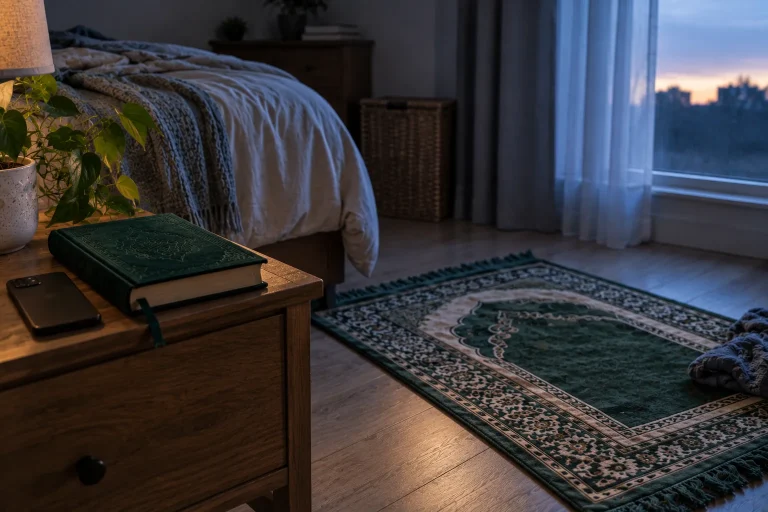
Understanding the Tilawat of the Quran
Tilawat of the Quran means reciting Allah’s Book correctly and following what it says. The Arabic root t-l-w means “to follow.” So proper tilawat joins three things: accurate pronunciation (tajweed), reflection on meaning, and acting on the verses. Reading alone is qira’ah; tilawat is reading that changes how you live.
Table of Contents
What Tilawat Really Means
Ask ten Muslims what tilawat means, and nine will say “reciting the Quran.” They are not wrong. They are just not finished.
Most of us were taught that tilawat means recitation. That is only half of it. Understanding the tilawat of the Quran starts with the word itself.
It comes from the root t-l-w, which means to follow. Same root as tāli, the one who comes after. So when Allah describes true believers, He says:
الَّذِينَ آتَيْنَاهُمُ الْكِتَابَ يَتْلُونَهُ حَقَّ تِلَاوَتِهِ أُولَٰئِكَ يُؤْمِنُونَ بِهِ
“Those to whom We have given the Book recite it with its true recital. They are the ones who believe in it.”
Qur’an 2:121 — Surah Al-Baqarah
Ibn Abbas (RA) explained what its true recital means:
- Treat as lawful what it makes lawful
- Treat as forbidden what it forbids
- Recite it as it was revealed
- Do not twist its meaning
Look closely. Three of those four have nothing to do with your voice.
Al-Raghib al-Isfahani put it best: every tilawat is reading, but not every reading is tilawat. Reading is the mouth. Tilawat is the mouth, the heart, and the life.
| Just Reading | True Tilawat |
|---|---|
| Getting through the words | Reciting them correctly and with respect |
| Speed is the priority | Pronunciation and Tajweed matter |
| Reflection may not happen | Reflection is the point |
| A reading habit | An act of worship |
The Reward Behind Every Single Letter
The benefits of reading Quran start before you understand a word of it.
مَنْ قَرَأَ حَرْفًا مِنْ كِتَابِ اللَّهِ فَلَهُ بِهِ حَسَنَةٌ، وَالْحَسَنَةُ بِعَشْرِ أَمْثَالِهَا
“Whoever recites a letter from the Book of Allah, he will be credited with a good deed, and a good deed gets a ten-fold reward. I do not say that Alif-Lam-Mim is one letter, but Alif is a letter, Lam is a letter and Mim is a letter.”
— Jami’ at-Tirmidhi 2910 (hasan sahih)
Sit with that for a second. A child sounding out Alif, Lam, Mim. Three letters. Thirty rewards. Before they know what it means.
And the Quran does not forget the people who kept its company. The Prophet ﷺ said it will come on the Day of Resurrection as an intercessor for its companions. (Sahih Muslim 804)
Abu Musa al-Ash’ari (RA) narrated a comparison. The believer who recites is like a citron — sweet in taste, sweet in fragrance. The believer who does not is like a date. Sweet, but with no scent at all. (Sahih al-Bukhari 5427)
The faith is there either way. Recitation is what adds the fragrance.
These are the spiritual benefits of recitation that no other act of worship replaces.
Tartil: The Rule That Governs All the Rest
If you learn one thing about the rules of Quran recitation, learn this one:
وَرَتِّلِ الْقُرْآنَ تَرْتِيلًا
“And recite the Quran with measured recitation.”
Qur’an 73:4 — Surah Al-Muzzammil
Ali (RA) was asked what tartil means. His answer was five words long:
“Give the letters their rights, and know where to stop.”
Two halves.
Giving letters their rights is technical — and that is the meaning of tajweed. But knowing where to stop is not technical at all. You cannot know where a sentence ends unless you understand it.
So correct Quranic pronunciation and understanding were tied together from the very first generation.
Umm Salamah (RA) described the Prophet’s ﷺ recitation as separated, verse by verse, never run together in a rush. That is why teaching Tajweed at home works best when it starts slow. Not because slow is easier. Because slow is correct.
The Three Speeds of Recitation
All three are valid. The right one depends on what you are doing.
Tarteel (تَرْتِيل) — the pace of reflection
The slowest of the three. Every letter given its full right, with room to think. Best for Tahajjud and for learning.
Tadweer (تَدْوِير) — the pace you can keep
The comfortable middle. Not slow, not rushed. This is the speed of a routine that survives a busy month.
Hadr (حَدْر) — the Ramadan pace
Quicker, but still observing tajweed. Useful when you are covering long portions.
Think walking pace, brisk walk, jog. None of them is a sprint. Ibn Mas’ud (RA) is reported to have warned people against racing through the Quran the way someone scatters dates in a hurry.
Three Things Most Muslims Don’t Know
- The Quran is an oral book. The mushaf is the backup. A qari with an ijazah can name his teacher, his teacher’s teacher, and every link after that — around 28 to 30 names back to the Prophet ﷺ. That chain of voices is the real transmission.
- There are ten canonical readings, not one. Yours is almost certainly Hafs ‘an ‘Asim, recited by roughly 95% of the world. Warsh ‘an Nafi’ is the norm across Morocco and West Africa. Both are equally the Quran.
- The melody is culture. The tajweed is religion. Egyptian recitation uses Arabic musical modes — Bayati, Hijaz, Saba. That is taste. Tajweed is binding on everyone.
What Happens If You Make a Mistake?
This one question stops more adults from reciting than anything else.
The honest answer: it depends on the kind of mistake, and scholars separated them into two.
- Lahn jali — the clear error. It changes a letter, a vowel ending, or the meaning. Reading an’amta as an’amtu. Mixing ص with س. This must be corrected, especially in Al-Fatihah during salah.
- Lahn khafi — the hidden error. A madd shortened from four counts to two, a weak ghunnah. It does not change meaning, it is not sinful, and it does not invalidate your prayer.
Now the part your heart needs.
الَّذِي يَقْرَأُ الْقُرْآنَ وَهُوَ مَاهِرٌ بِهِ مَعَ السَّفَرَةِ الْكِرَامِ الْبَرَرَةِ، وَالَّذِي يَقْرَأُ الْقُرْآنَ وَيَتَتَعْتَعُ فِيهِ وَهُوَ عَلَيْهِ شَاقٌّ لَهُ أَجْرَانِ
“The one who is proficient in the recitation of the Qur’an will be with the honourable and obedient scribes, and he who recites the Quran and finds it difficult to recite, doing his best, will have two rewards.”
— Sahih al-Bukhari 4937, Sahih Muslim 798
Read that again if you are the parent who stumbles.
The struggle is not being tolerated. It is being rewarded twice.
If we pause and look… we may all have a few lahn khafi mistakes. Mistakes we never noticed. Simply because khafi means hidden. Take this as a gentle sign. Why not give twenty minutes a week to a qualified teacher, and let your tilawat be corrected?
This is exactly what a teacher is for. Our Al-Azhar certified teachers correct gently, in real time, one student at a time. Try a free class with Qari For Kids.
How to Build a Daily Tilawat Habit
Consistency beats intensity. Small and daily wins.
- Fix the time, not the amount. Same slot every day, straight after Fajr or Isha. Even half a page. The slot is what survives a busy week.
- Keep word-by-word translation open. Catch what you can as it passes, then check. Do not read the English first.
- Learn the frequent words. About 300 root words make up roughly 80% of the Quran. Twenty a week changes what you hear in salah.
- Narrow your range. Instead of a new juz daily, go deep on Al-Mulk, Ya-Sin, the last juz. Recognition compounds fast.
- Grammar last. Vocabulary first, always. Starting with nahw is where most learners quit.
Six months of honest daily work. That is usually enough to follow a recitation without a translation open.
The one change that makes people stick with it? Planning your daily Quran portion around a fixed prayer time. And for many, that is the moment the Quran stops feeling like homework. The moment finding peace through recitation becomes the reason they show up.
These small habits are the real etiquettes of tilawat — the ones nobody writes on a poster.
Final Takeaway
Tilawat was never a test of your accent. The word means to follow, and that is the whole instruction.
Recite as correctly as you can manage today, understand a little more than you did last month, and let what you read show up somewhere in how you live.
That is haqqa tilawatih. And your child does not need to be perfect to begin. Neither do you.
Start where you are. Qari For Kids offers one-to-one online Quran classes for children and adults, with certified male and female teachers from Al-Azhar University. Book your free trial class at qariforkids.com
Give Your Child the Gift of the Quran This Ramadan
Start Online Quran Classes at Qari For Kids
1-on-1 certified tutors. Flexible scheduling around Ramadan hours. Free trial for families in USA, UK, Canada & Australia.
Give Your Child the Gift of the Quran This Ramadan
Start Online Quran Classes at Qari For Kids
1-on-1 certified tutors. Flexible scheduling around Ramadan hours. Free trial for families in USA, UK, Canada & Australia.
Featured Blogs
- Quran recitation for peace - A simple guide to calm the heart
- 10 Ways to teach kids about the mercy of ramadan
- What is Ramadan Mercy-Simple Stories for Kids
- The Path to Hifz – Quran Memorization Techniques and Rewards
- Seeking Forgiveness in Second Ashrah – Days of Maghfirah
- Second Ashrah Dua Ramadan – Days of Forgiveness
AUTHORED BY
Qari For Kids Editorial Team
Certified Quran & Arabic Educators
Our team of Ijazah-certified Qaris brings together over a decade of teaching Quran to children and adults across the USA, UK, Canada, and Australia.
- Ijazah-certified tutors
- 10,000+ students taught
- Reviewed by Islamic scholars
- Ijazah-certified tutors
Main Courses
Follow Us On:
Frequently Asked Questions
What is the difference between tilawat, qira'ah and tajweed?
Qira’ah is reading. Tajweed is how the letters are pronounced. Tilawat is all of it, plus following what you read.
Is my tilawat valid if I don't understand Arabic?
Yes, and it is rewarded letter by letter. Understanding is the goal you grow into, not a condition to start.
Do I need to learn tajweed before I start?
No. Start now, learn as you go. Only errors that change meaning need urgent fixing.
How many sajdah tilawat are in the Quran?
Fourteen or fifteen, depending on the school. Hanafis count Surah Sad 38:24; Shafi’is count the second sajdah in Al-Hajj 22:77 instead.
What if I make a mistake mid-recitation?
Outside salah, repeat the phrase correctly once and carry on. Do not spiral. The person who stops every three words never finishes a page.
Can I recite without wudu?
Reciting from memory, yes, according to the majority. Touching the mushaf directly is where wudu is required.
Editorial Note: The views and guidance in this article are drawn from established Islamic scholarly tradition and are intended for general educational purposes. Individual circumstances vary — for specific fiqh questions about fasting for children or those with health conditions, please consult a qualified Islamic scholar. Qari For Kids is an educational platform and does not issue religious rulings.
Explore Other Blogs
In this article, we will look closely at each pillar, explain what it means, share their Arabic names, and highlight guidance from the…

What Is Islam? The word “Islam†comes from the Arabic root S-L-M, which signifies peace, submission, and safety…
Written & Reviewed by Mufti Habib Ahmed Mufti Habib Ahmed is a Dars‑e‑Nizami graduate from Jamia Farooqia Karachi…