
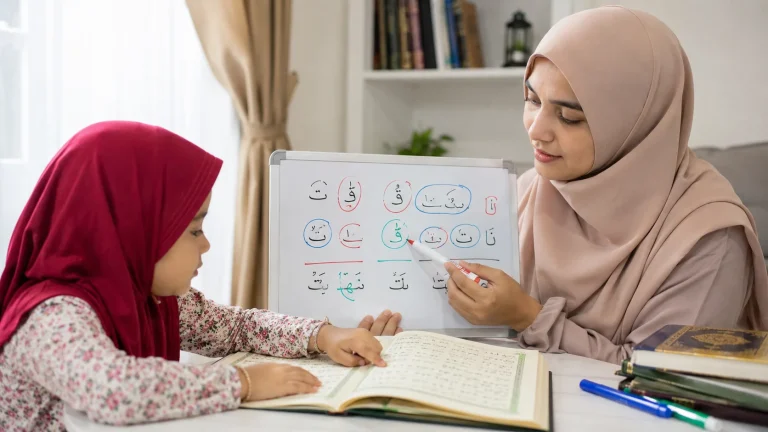
Children with short attention spans can still learn Quran beautifully when lessons are short, gentle, visual, repeated, and connected with love. The goal is not to force long sitting, but to build a calm routine where the child listens, repeats, understands, moves a little, rests, and comes back with interest.
For a full day-by-day structure, see our Daily Quran Routine for Kids (Ages 5-10).
If your child is refusing Quran time altogether, this related guide can help: Child Refuses to Read Quran? Gentle Parent Guide.
The right materials also make a big difference – see our roundup of the best books and tools to help your child learn Quran faster.
Table of Contents
- Why Short Attention Spans Need a Different Quran Plan
- The Real Goal: Build Love Before Long Lessons
- Start With a Fixed Time and Place
- Keep Quran Lessons Short and Focused
- Use Active Learning, Not Passive Listening
- Teach With Repetition, Rhyme, and Gentle Recall
- Add Brain Breaks and Movement Breaks
- Use Colors, Whiteboards, and Simple Tajweed Cues
- Begin With Short Surahs and Small Wins
- Protect Focus From Phones and Distractions
- Use Sleep and Revision to Strengthen Memory
- A Sample Quran Routine for Busy Families
- When ADHD or Focus Issues Need Extra Support
- How Qari for Kids Can Help Parents
- Conclusion
- FAQs
1. Why Short Attention Spans Need a Different Quran Plan
Some children cannot sit still for long Quran lessons. They may move around, look away, forget quickly, or lose interest after only a few minutes. This does not always mean the child is lazy, disrespectful, or careless. Sometimes the lesson is simply too long, too heavy, or too difficult for the child’s age and focus level.
A child with a short attention span needs a different Quran plan. The goal is not to force the child to behave like an adult. The goal is to teach Quran in a way the child can receive, enjoy, and repeat.
The better question is not, “Why does my child not focus?”
The better question is, “What kind of Quran routine helps this child focus?”
Allah Subhana Wataala says:
This ayah reminds us that Quran learning should be made accessible. It should not become unnecessarily heavy for children. If the method is too strict or too long, the child may begin to fear Quran time instead of loving it.
Sometimes the child is not rejecting the Quran. The method is simply too heavy for the child’s age, energy, or attention span.
2. The Real Goal: Build Love Before Long Lessons
Before a child can sit for longer Quran lessons, the child must first feel love for the Quran. Love comes before performance. Connection comes before correction.
A child should not meet the Quran only through pressure, targets, mistakes, and strict reminders. If every Quran lesson begins with “Sit properly,” “Why don’t you remember?” or “You always make the same mistake,” the child may slowly connect Quran time with stress.
Children develop love for the Quran when it becomes a natural and peaceful part of home life. They should hear Quran recitation at home, see their parents reciting, listen to Quran stories, and feel that Quran brings calmness into the house.
Parents can begin with small things:
- Play beautiful Quran recitation softly at home.
- Let the child see you reading Quran.
- Share simple Quran stories.
- Praise small progress.
- Start Quran time with a smile and dua.
- Avoid turning every lesson into a test.
The Prophet Muhammad ﷺ taught gentleness. In Sahih Muslim, it is mentioned that kindness beautifies a matter, and when kindness is removed, it makes the matter defective.
This is very important in Quran teaching. A gentle teacher can correct more deeply than a harsh one. A child who feels safe learns better. A child who feels loved comes back more willingly.
3. Start With a Fixed Time and Place
Children with short attention spans need routine. A fixed time and place helps the child know what to expect. When Quran time keeps changing every day, the child’s mind may not settle easily.
A simple routine can make a big difference.
For example:
- Same time every day
- Same quiet place
- Same Quran book or device
- Same short opening dua
- Same small goal
A parent may choose a time after Maghrib, after school rest, or before bedtime. The best time is the time when the child is not too hungry, sleepy, angry, or overstimulated.
The place should also be simple. A clean table, a Quran, a pencil, water, and maybe a whiteboard are enough. Remove toys, TV noise, phone notifications, and unnecessary screens.
When the environment is calm, the child’s mind becomes calmer too.
This is where parents can focus on creating shorter, focused routines that the child can follow daily without pressure.
4. Keep Quran Lessons Short and Focused
A short lesson is not a weak lesson. A short lesson can be powerful if it is focused and repeated regularly.
For many children, a 10-minute focused Quran lesson is better than a 40-minute lesson full of stress, crying, distraction, and correction. The aim is to let the child finish the lesson with confidence, not shame.
For young children, even 7 to 12 minutes may be enough. Older children may manage 15 to 20 minutes, depending on their level and personality.
The lesson should have one small goal.
For example:
- One line only
- One ayah only
- Three difficult words
- One Tajweed rule
- One short Surah revision
- One pronunciation correction
A simple lesson can look like this:
| Time | Activity |
|---|---|
| 2 minutes | Listen to the teacher or parent |
| 4 minutes | Repeat after the teacher |
| 3 minutes | Read independently |
| 1 minute | Praise, correction, and dua |
Allah Subhana Wataala says:
This ayah also teaches us not to rush knowledge. Quran learning should be slow, careful, and sincere. A child does not need to finish quickly. A child needs to learn properly.
5. Use Active Learning, Not Passive Listening
Some children lose focus because the lesson is too passive. If the teacher speaks the whole time and the child only listens, the child may mentally leave the lesson.
Active learning means the child participates.
The child should:
- Listen
- Repeat
- Point to the word
- Circle a letter
- Answer simple questions
- Read aloud
- Trace the sound
- Explain one small thing back
This is especially useful for children with short attention spans. Their mind stays more awake when they are doing something.
A teacher can ask simple questions:
- Which letter did we stretch?
- Where is the qalqalah sound?
- Can you show me the word we just read?
- Which sound was difficult?
- Can you repeat only this part?
Active learning in Islam is not only about collecting information. It means learning with attention, reflection, practice, and participation.
The Quran itself invites people to think, reflect, listen, and act. So Quran learning should not be dry or mechanical. It should be alive.
This is also where teachers and parents should focus on adapting teaching methods for all children, because every child does not learn in the same way.
6. Teach With Repetition, Rhyme, and Gentle Recall
Repetition is a major part of Quran learning. It is not outdated. The Quran has always been learned through listening, repeating, correcting, and revising.
But repetition should not feel like punishment.
Instead of saying, “Repeat it again and again,” the parent or teacher can make repetition gentle and rhythmic.
For example:
- Listen once.
- Repeat with the teacher.
- Repeat softly.
- Repeat loudly.
- Cover the word and recall.
- Read again after a short pause.
Rhyme and rhythm help children remember. Many children remember better when the recitation has a steady flow. This is why listening before reciting is very useful.
A simple memorization method can be:
- Listen to the ayah.
- Repeat small parts.
- Join the parts together.
- Recite without looking.
- Review after a break.
- Revise the next day.
The Prophet Muhammad ﷺ said:
“The best among you are those who learn the Quran and teach it.”
(Sahih al-Bukhari)
This hadith shows the honor of Quran learning and teaching. But teaching should be done with wisdom, patience, and care.
7. Add Brain Breaks and Movement Breaks
Movement is not always misbehavior. Some children need movement to return to focus.
A child may not be able to sit still for 20 minutes, but that same child may learn well in two 8-minute lessons with a small break in between.
Brain breaks can be very simple:
- Stretch arms
- Drink water
- Walk to the door and back
- Take three deep breaths
- Change sitting position
- Stand and repeat one ayah
- Clap softly for syllables or rhythm
A simple Quran learning pattern can be:
| Learning Time | Break Time | Review Time |
|---|---|---|
| 10 minutes | 2 minutes | 5 minutes |
A movement break is not a failure of discipline. For some children, it is the bridge back to focus.
Parents should not feel guilty if their child needs breaks. The goal is not to make the child sit like a statue. The goal is to help the child learn Quran with attention and love.
8. Use Colors, Whiteboards, and Simple Tajweed Cues
Children often understand better when they can see the lesson clearly. A whiteboard, colored markers, and simple visual signs can make Quran learning easier.
A teacher can use:
- One color for stretching
- One color for ghunnah
- One color for qalqalah
- Circles for difficult letters
- Arrows for joining sounds
- Underlines for long vowels
But colors should be used carefully. Too many colors can distract the child. Keep it simple.
For Tajweed, avoid long technical explanations at the beginning. The child does not need a lecture. The child needs a clear sound, a simple example, and gentle correction.
For Noorani Qaida, focus first on:
- Letter recognition
- Correct sound
- Joining letters
- Short vowels
- Long vowels
- Clear pronunciation
Allah Subhana Wataala says:
This ayah connects beautifully with Tajweed. Quran should be recited slowly, clearly, and carefully. Children can learn this step by step when the teacher makes the rules simple.
9. Begin With Short Surahs and Small Wins
Children need small wins. When a child feels successful, the child becomes more willing to continue.
Short Surahs are helpful because they give children confidence. They can complete something, revise it, and feel happy about their progress.
Good starting Surahs may include:
- Surah Al-Fatihah
- Surah Al-Ikhlas
- Surah Al-Falaq
- Surah An-Nas
- Surah Al-Kawthar
- Surah Al-Asr
The teacher should not rush the child into long memorization before the child is ready. Reading comfort, sound clarity, and love for Quran should come first.
Parents should also correct gently. If a child reads five words and only one word needs correction, begin with praise.
For example:
“You read these four words beautifully. Let’s fix this one together.”
This small change protects the child’s confidence.
10. Protect Focus From Phones and Distractions
Digital distractions can make Quran learning much harder. A child may sit with the Quran open, but if the TV is on, the phone is ringing, and people are talking nearby, the child’s focus will break again and again.
Parents should create a simple rule:
No notifications during Quran time.
If a device is needed for online Quran class or audio recitation, only the Quran lesson should be open. Other apps, games, videos, and messages should be closed.
A clean learning space helps the child focus better.
Helpful steps:
- Turn off TV.
- Keep phones away.
- Close unnecessary tabs.
- Avoid multitasking.
- Keep the table clean.
- Use headphones if needed.
- Choose a quiet corner.
Focus in Quran is not only a learning skill. It is also adab with the words of Allah Subhana Wataala.
11. Use Sleep and Revision to Strengthen Memory
Sleep is very important for memory. A tired child may look careless, but sometimes the brain is simply overloaded.
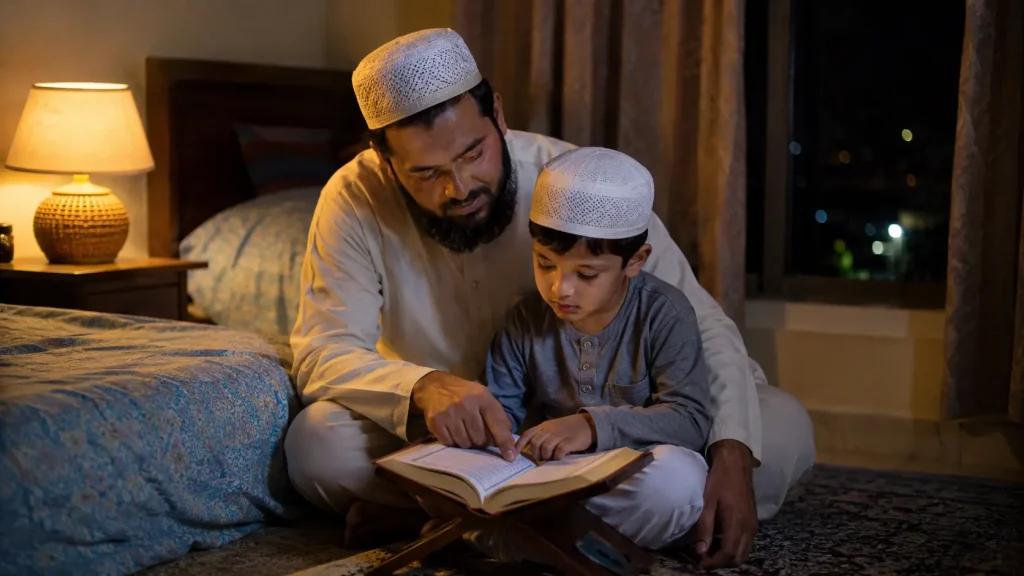
If a child is exhausted, hungry, or sleepy, memorization becomes harder. Parents should avoid forcing difficult memorization very late at night when the child can barely stay awake.
A small review before sleeping can be helpful.
For example:
- Listen to the ayah once.
- Recite it once.
- Sleep.
- Revise it the next day.
This method is simple but powerful. The child does not need a long night lesson. A short peaceful review can help the brain hold the lesson better.
Successful Quran students do not only memorize. They revise, sleep properly, and return to the lesson again.
12. A Sample Quran Routine for Busy Families
Every family has a different schedule. Some parents work long hours. Some children have school, homework, and other activities. The Quran routine should be realistic.
Here is a simple guide:
| Learner Type | Best Lesson Style | Routine Example |
|---|---|---|
| Young child | Very short, visual, playful | 7 minutes after Maghrib |
| Restless child | Short lesson with movement break | 10 minutes learning + 2-minute stretch |
| Hifz student | Listen, repeat, recall | 15 minutes morning + 5 minutes night |
| Busy school child | Small daily revision | 10 minutes after homework |
| Working adult/student | Fixed review slot | 20 minutes before sleep or after Fajr |
A strong routine should include:
- Same time
- Same place
- Small target
- Short revision
- Gentle correction
- Parent encouragement
- Dua at the end
Parents should remember that consistency is more important than long lessons. Five short lessons in a week are better than one long stressful lesson.
13. When ADHD or Focus Issues Need Extra Support
Not every restless child has ADHD. Some children are simply young, energetic, tired, bored, or overwhelmed.
However, if a child struggles with focus in Quran class, school, home routines, and daily tasks, parents may need professional advice. This blog is not for medical diagnosis. It is for Quran learning support at home.
Children with ADHD-like focus challenges may benefit from:
- One-on-one Quran teaching
- Shorter lessons
- Visual schedules
- Movement breaks
- Simple goals
- Parent-teacher feedback
- Positive reinforcement
- Less screen distraction
- Flexible lesson timing
The teacher should adjust the method instead of shaming the child.
A child who needs extra support is not a bad child. That child may simply need a calmer, shorter, and more interactive way to learn.
14. How Qari for Kids Can Help Parents
Some children learn better with a patient teacher outside the emotional pressure of the parent-child relationship. Parents may become frustrated, and children may become defensive. A calm teacher can create a better learning space.
Qari for Kids helps children learn Quran online with structure, patience, and care. Lessons can be adjusted according to the child’s age, level, and attention span.
Qari for Kids can help with:
- Online Quran classes
- Noorani Qaida
- Tajweed correction
- Quran recitation
- Hifz support
- Short focused lessons
- Male and female Quran teachers
- Flexible timing for families in the USA, UK, Europe, Australia, and other countries
For children with short attention spans, the right teacher can make a big difference. The lesson should feel calm, clear, and possible.
Want your child to learn Quran with patience and structure? Qari for Kids offers gentle online Quran classes with qualified male and female teachers, including Al Azhar-certified teachers, so every child can learn at a pace that feels comfortable and steady.
15. Conclusion
Teaching Quran to children with short attention spans is not about forcing them to sit longer. It is about teaching smarter, softer, and with more understanding.
Do not measure Quran learning only by minutes. Measure it by love, consistency, confidence, and steady progress.
A short lesson can become a strong habit. A gentle correction can protect the child’s heart. A small daily routine can build a lifelong connection with the Quran.
Parents should keep making dua, stay patient, and avoid comparing their child with others. Every child has a different pace. What matters is that the child keeps moving toward the Quran with love.
The Quran entered the hearts of this Ummah through mercy, repetition, listening, and love. Our children deserve the same path.