
My Child Doesn’t Want to Read Quran: A Gentle Guide for Parents
Added by : QFK Editorial Team
Published On : June 16, 2026
Islamic Date : 1 Muharram, 1448
Last Updated : June 16, 2026
Added by : QFK Editorial Team
Published On : June 16, 2026
Islamic Date : 1 Muharram 1448 AH
Last Updated : June 16, 2026
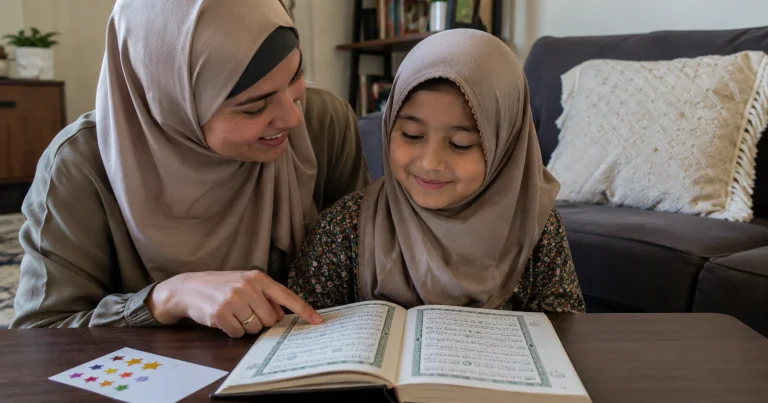
Child Refuses to Read Quran? Gentle Parent Guide
When a child does not want to read Quran, the real reason is often hidden. It may be strict teaching, repeated scolding, fear, mobile distraction, difficult lessons, or lack of interest. The solution is not more pressure. The solution is love, patience, routine, encouragement, and a Quran environment that feels peaceful.
If short focus is part of the issue, our guide on how to teach Quran to children with short attention spans has practical techniques.
If resistance continues, it may be worth reading Should You Use an Online Quran Tutor for Kids? to see if outside support could help.
Building a light, low-pressure habit often helps too – see our Daily Quran Routine for Kids (Ages 5-10).
On This Page
- Why Children Avoid Quran Reading
- The Real Problem Is Often the Method
- Do Not Make Quran Learning Feel Like Pressure
- Start With Small and Easy Steps
- Praise the Child’s Small Progress
- Use Quran Stories to Build Interest
- Create a Quran Environment at Home
- Choose the Right Teacher and Time
- Balance Mobile, Games, and Quran Routine
- Use Breaks and Child-Friendly Learning
- Help the Child Understand the Meaning
- Make Dua for the Child’s Heart
- When Online Quran Classes Can Help
- FAQs
- Conclusion
Why Children Avoid Quran Reading
Many parents feel worried when their child says:
“I don’t want to read Quran.”
It hurts the parent’s heart.
A Muslim parent wants the child to love the Quran, read it beautifully, understand it, and stay close to Allah ﷻSo when the child avoids Quran class or makes excuses, the parent may think the child is careless.
But this is not always true.
Sometimes the child is not rejecting the Quran.
The child may be rejecting the feeling attached to Quran time.
- Maybe the class feels too strict.
- Maybe the teacher corrects every mistake harshly.
- Maybe the child is scolded again and again.
- Maybe the lesson is too long.
- Maybe the child is forced to read when tired.
- Maybe the child enjoys games and mobile more because they are easy and entertaining.
- Maybe the child thinks Quran reading is too difficult.
So before asking, “How do I force my child to read?” ask a better question:
“What is making my child avoid Quran time?”
This small change helps parents understand the real issue.
The Real Problem Is Often the Method
A child may love Allah ﷻ but still feel scared of Quran class.
This happens when Quran learning becomes connected with fear, pressure, or shame.
A child hears:
- “Read properly.”
- “Why are you making mistakes?”
- “You never focus.”
- “Other children read better than you.”
Slowly, the child starts feeling heavy before the class even begins.
This is where parents need to be very careful.
The Quran is the Book of Allah ﷻ It should enter the child’s life with respect, love, and peace. It should not feel like a punishment or daily stress.
The Prophet Muhammad ﷺ taught with softness and ease. He did not make religion hard for people.
The Prophet Muhammad ﷺ said:
“Make things easy and do not make things difficult. Give glad tidings and do not drive people away.”
(Sahih al-Bukhari)
This Hadith is very important for parents and teachers.
It does not mean children should do whatever they want.
It means guidance should be wise.
A child needs discipline, but not harshness.
A child needs correction, but not humiliation.
A child needs routine, but not pressure that closes the heart.
Do Not Make Quran Learning Feel Like Pressure
One big mistake is making the Quran feel like a punishment.
For example:
- “You misbehaved, now go read Quran.”
- “You did not listen, so you must read one page.”
- “You are wasting time, go sit with your Quran.”
These words may look normal, but they create a wrong connection in the child’s mind.
The child begins to feel:
- Quran means punishment.
- Quran means scolding.
- Quran means I did something wrong.
- This is dangerous.
- Quran should feel like light, not penalty.
Instead, parents can say:
“Come son, let’s read together for five minutes.”
“You did well yesterday. Today we will do a little more.”
“This is the Book of Allah ﷻ When we read it, Allah ﷻbecomes pleased with our effort.”
“Let’s read a small part, then you can take a break.”
These lines are soft, but still clear.
They guide the child without breaking the child’s heart.
Allah ﷻsays:
لَا إِكْرَاهَ فِي الدِّينِ
“There is no compulsion in religion.”
(Surah Al-Baqarah 2:256)
This does not mean parents should stop teaching Quran. Parents must guide their children.
But love cannot be forced into the heart through anger.
Love grows through patience, example, and mercy.
Start With Small and Easy Steps
Many children avoid Quran reading because it feels too hard.
A full page feels too much.
A long class feels boring.
Tajweed rules feel confusing.
Noorani Qaida may feel repetitive.
Arabic letters may feel difficult.
So the child says, “I don’t want to read.”
The solution is not to leave Quran learning.
The solution is to make it easier.
- Start small.
- One line.
- One ayah.
- One letter sound.
- One short Surah.
- Five minutes.
- One small revision.
If the child struggles with one word, break it into smaller sounds.
If the child cannot sit for twenty minutes, start with seven minutes.
If the child gets bored with plain reading, add meaning, stories, or short questions.
Allah ﷻsays:
وَلَقَدْ يَسَّرْنَا الْقُرْآنَ لِلذِّكْرِ فَهَلْ مِنْ مُدَّكِرٍ
“And We have certainly made the Quran easy for remembrance, so is there anyone who will remember?”
(Surah Al-Qamar 54:17)
This ayah gives hope.
The Quran is not impossible.
But children need the right method.
Small steps make the child feel:
“I can do this.”
That feeling is very powerful.
Once a child feels success, interest begins to grow.
Praise the Child’s Small Progress
Children need appreciation.
Sometimes parents only notice mistakes.
The child reads ten words correctly and makes one mistake. The parent immediately says:
“No, wrong.”
But the child feels:
“I am always wrong.”
This can reduce confidence.
A better way is:
“MashaAllah ﷻ, you read most of the line nicely. This word is a little tricky. Let’s fix it together.”
Or:
“MashaAllah ﷻ, Allah ﷻhelped you read better today.”
This kind of praise does two things.
It makes the child happy.
It connects the child’s effort with Allah ﷻ
Small rewards can also help.
For example:
- A star chart.
- A small weekly gift.
- A certificate.
- A family appreciation message.
- Extra story time.
- A favorite snack after class.
- A voice note sent to grandparents.
But rewards should not become the only reason to read Quran.
Use rewards as a bridge.
The real goal is love.
When a child feels proud of small progress, the child becomes ready for bigger progress.
Use Quran Stories to Build Interest
Children love stories.
Before they love long lessons, they love stories.
This is why Quran stories are so powerful for young hearts.
If a child reads Arabic every day without understanding anything, the lesson may feel dry. The child may respect the Quran, but not feel connected yet.
So give meaning.
Tell stories.
Explain simple lessons.
Then read a related ayah.
For example:
- Tell the story of Prophet Yousuf عليه السلام and speak about patience.
- Tell the story of Prophet Musa عليه السلام and speak about courage.
- Tell the story of Prophet Nuh عليه السلام and speak about never giving up.
- Tell the story of the people of the cave and speak about young people staying close to Allah ﷻ
- Tell the story of Surah Al-Fil and speak about how Allah ﷻprotects what He wills.
Keep it simple.
Do not turn every story into a lecture.
A good method is:
- Tell the story.
- Ask one question.
- Read one short ayah.
- Explain one lesson.
- End with a small dua.
This is one of the best ways of making Quran learning enjoyable.
A child who understands even a little meaning will feel more curious.
Curiosity opens the heart.
Create a Quran Environment at Home
Children copy what they see.
If parents say, “Read Quran,” but the child never sees them reading Quran, the message becomes weak.
A home needs a Quran environment.
This does not mean the home must be perfect.
It means the child should see that Quran is part of family life.
For example:
After Maghrib, the family sits for ten minutes.
One person reads.
One child repeats.
A parent explains one small meaning.
Everyone makes dua.
That is enough.
Even fifteen minutes can make a difference.
The child begins to feel:
“Quran is not only my class. Quran is our family habit.”
This feeling is beautiful.
Parents should also avoid saying only:
“You go and read.”
Instead, say:
“Come, we will read together.”
Or:
“I am also reading. Sit with me.”
This changes the whole mood.
Quran time becomes warmer.
The home becomes calmer.
The child feels included, not forced.
Choose the Right Teacher and Time
Sometimes the child is not the problem.
- The method is the problem.
- The teacher may be too strict.
- The class may be too long.
- The timing may be wrong.
The curriculum may not match the child’s age.
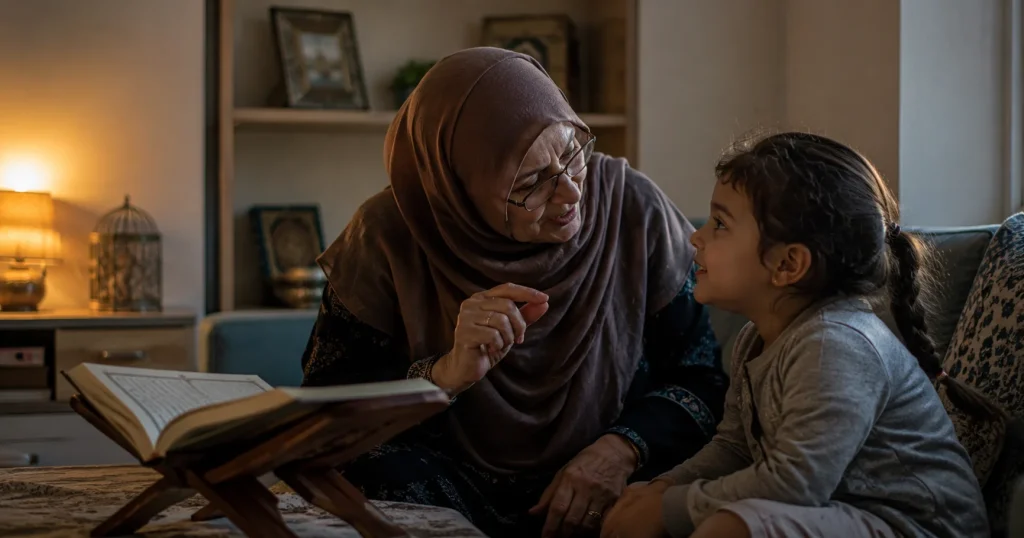
- A good Quran teacher is very important.
- A good teacher corrects mistakes, but does not insult the child.
- A good teacher understands the child’s mood.
- A good teacher knows when to repeat, when to praise, when to slow down, and when to stop.
- A child should not fear the teacher.
Respect is good.
Fear is not.
Timing also matters.
Do not choose a time when the child is hungry, sleepy, angry, or just back from school.
A tired child may look lazy, but actually the child has no energy.
Choose a time when the child is fresh.
For some children, after Fajr works.
For others, after rest works.
For some, evening is better.
There is no one perfect time for every family.
The best time is the time when the child can focus without pressure.
The curriculum should also be age-friendly.
- For beginners, Noorani Qaida is helpful.
- For children who can read, fluency matters.
- For older children, Tajweed can be added step by step.
- For children who get bored, stories and meanings should be included.
The goal is not only to complete pages.
The goal is to build a strong connection.
Balance Mobile, Games, and Quran Routine
Many children today are deeply attached to mobile phones, games, and videos.
This affects attention.
Games give fast excitement.
Videos change every few seconds.
Mobile gives quick reward.
Then Quran class feels slow.
This does not mean the child is bad.
It means the child’s mind is used to fast entertainment.
Parents need a smart routine.
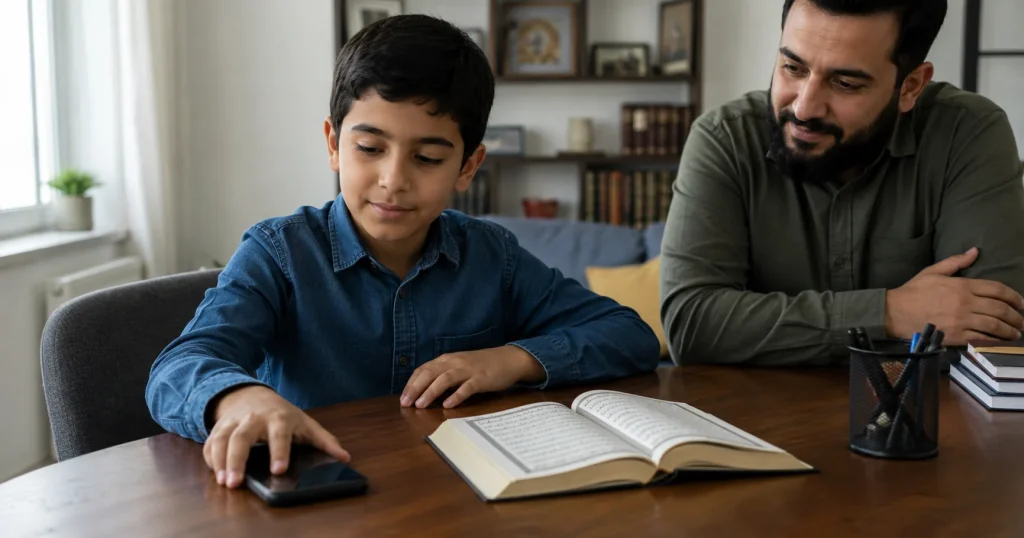
- Do Quran before screen time, not after long gaming.
- Keep the lesson short.
- Remove mobile during class.
Use a simple rule:
“First Quran, then screen.”
For example:
“First ten minutes Quran, then you can play.”
This works better than shouting again and again.
Also, reduce unnecessary screen time slowly.
Do not suddenly remove everything and create a fight.
Build balance.
A child can enjoy play and still learn Quran.
But the home routine should show that Quran comes first.
This is part of engaging reluctant learners in a practical way.
Use Breaks and Child-Friendly Learning
Children are not adults.
They cannot always sit for long classes.
Some children can focus for thirty minutes.
Some cannot focus for even ten minutes in the beginning.
That does not mean they are careless.
It means they need a child-friendly method.
Use breaks.
- For a young child, try:
- Seven minutes reading.
- Two minutes break.
- Five minutes revision.
- One small praise.
- For an older child:
- Fifteen minutes reading.
- Five minutes break.
- Ten minutes Tajweed or memorization.
This is much better than forcing one long class where the child becomes tired and irritated.
You can also use:
- Digital whiteboards.
- Letter cards.
- Short quizzes.
- Recitation games.
- Repeat-after-me practice.
- Child reciter videos.
- Small recording tasks.
One beautiful idea is to let the child record a short recitation and share it with family.
When grandparents, uncles, aunts, or siblings appreciate the child, confidence grows.
The child thinks:
“They liked my recitation. I want to improve.”
Confidence is a strong cure for resistance.
Help the Child Understand the Meaning
Many children read Quran but do not know what they are reading.
For non-Arabic speaking children, this can become difficult.
They may read the words, but the heart does not connect yet.
This is why simple meaning is important.
Do not overload the child with long tafsir.
- Start small.
- One ayah.
- One meaning.
- One lesson.
For example, when teaching:
إِنَّ مَعَ الْعُسْرِ يُسْرًا
“Indeed, with hardship comes ease.”
(Surah Ash-Sharh 94:6)
You can say:
“Allah ﷻis telling us that hard times do not last forever. Ease will come.”
That is simple.
That is powerful.
The child begins to feel that Quran speaks to life.
Understanding brings love.
Recitation gives reward.
Understanding gives direction.
Both matter.
Make Dua for the Child’s Heart
After all methods, never forget dua.
A parent can arrange the best teacher, best time, best routine, and best rewards.
But guidance comes from Allah ﷻ
Make dua often:
“O Allah ﷻ put love of the Quran in my child’s heart.”
“O Allah ﷻ make Quran easy for my child.”
“O Allah ﷻ make my child among the people of Quran.”
Also make dua for yourself.
- Ask Allah ﷻfor patience.
- Ask for wisdom.
- Ask for a soft tongue.
Because sometimes the child needs guidance, and the parent needs calmness.
Allah ﷻsays:
“O believers! Protect yourselves and your families from a Fire…”
(Surah At-Tahrim 66:6)
This is a serious responsibility.
But it should be carried with mercy.
Parents are not only managing Quran lessons.
They are shaping the child’s relationship with the Book of Allah ﷻ
That relationship should be protected.
When Online Quran Classes Can Help
Sometimes parents try at home, but the child still does not respond.
In that case, a gentle one-on-one Quran class can help.
- Some children listen better to a teacher.
- Some children need structure.
- Some children need a fresh start with someone who is patient and calm.
Online Quran learning can help when:
- The child is shy.
- The child fears strict teachers.
- The child needs flexible timing.
- The child needs a female teacher.
- The child is starting Noorani Qaida.
- The child needs Tajweed correction.
- The child needs short, focused lessons.
The child needs personal attention.
At Qari for Kids, children and adults can learn Quran step by step with male and female teachers, flexible timings, and child-friendly online tools.
The aim is not only to finish a lesson.
The aim is to help the learner feel confident, comfortable, and connected to Quran learning.
CTA:
Book a Free Trial Class
Help your child begin Quran learning with comfort, confidence, and gentle guidance.
Give Your Child the Gift of the Quran This Ramadan
Start Online Quran Classes at Qari For Kids
1-on-1 certified tutors. Flexible scheduling around Ramadan hours. Free trial for families in USA, UK, Canada & Australia.
Give Your Child the Gift of the Quran This Ramadan
Start Online Quran Classes at Qari For Kids
1-on-1 certified tutors. Flexible scheduling around Ramadan hours. Free trial for families in USA, UK, Canada & Australia.
Conclusion
If your child does not want to read Quran, do not lose hope.
Look deeper.
- Maybe the child is not rejecting the Quran.
- Maybe the child is rejecting pressure.
- Maybe the lesson feels too hard.
- Maybe the teacher feels too strict.
- Maybe the timing is wrong.
- Maybe mobile and games have taken too much space.
- Maybe the child needs stories, praise, breaks, and a softer routine.
The Quran should enter a child’s life with love.
- Start small.
- Praise often.
- Read together.
- Tell stories.
- Choose the right teacher.
- Make the home peaceful.
- And keep making dua.
A child may forget many lessons.
But the child will remember how Quran time made them feel.
If Quran time feels calm, loving, and meaningful, the child’s heart slowly opens.
And when the Quran enters the heart with love, it becomes more than a lesson.
It becomes a lifelong connection with Allah ﷻ
Featured Blogs
- Quran recitation for peace - A simple guide to calm the heart
- 10 Ways to teach kids about the mercy of ramadan
- What is Ramadan Mercy-Simple Stories for Kids
- The Path to Hifz – Quran Memorization Techniques and Rewards
- Seeking Forgiveness in Second Ashrah – Days of Maghfirah
- Second Ashrah Dua Ramadan – Days of Forgiveness
AUTHORED BY
Qari For Kids Editorial Team
Certified Quran & Arabic Educators
Our team of Ijazah-certified Qaris brings together over a decade of teaching Quran to children and adults across the USA, UK, Canada, and Australia.
- Ijazah-certified tutors
- 10,000+ students taught
- Reviewed by Islamic scholars
- Ijazah-certified tutors
Main Courses
Follow Us On:
Frequently Asked Questions
Why does my child refuse to read Quran?
A child may refuse Quran reading because the lesson feels strict, boring, difficult, or forced. Sometimes the child is tired, afraid of mistakes, distracted by mobile, or unable to understand the meaning.
Should I force my child to read Quran?
Parents should guide their children, but harsh forcing can create fear. A better way is soft routine, small goals, praise, family Quran time, and a gentle teacher.
How can I make Quran learning easier for my child?
Start with small steps. Use one line, one ayah, one letter sound, or five minutes daily. Make the lesson short, clear, and suitable for the child’s age.
What if my child is always on mobile?
Set Quran time before screen time. Keep the rule simple: first Quran, then mobile. Reduce screen time slowly and make Quran time short and peaceful.
Is Noorani Qaida good for children?
Yes. Noorani Qaida helps children learn Arabic letters, joining, pronunciation, and basic reading. It should be taught slowly with praise and repetition.
Can Quran stories help my child?
Yes. Quran stories create interest and emotional connection. Children understand lessons better when they hear stories before reading related ayahs.
What is the best time for Quran class?
The best time is when the child is fresh, calm, and free. Avoid times when the child is hungry, sleepy, tired, or just back from school.
Editorial Note: The views and guidance in this article are drawn from established Islamic scholarly tradition and are intended for general educational purposes. Individual circumstances vary — for specific fiqh questions about fasting for children or those with health conditions, please consult a qualified Islamic scholar. Qari For Kids is an educational platform and does not issue religious rulings.
Explore Other Blogs

In this article, we will look closely at each pillar, explain what it means, share their Arabic names, and highlight guidance from the…

What Is Islam? The word “Islam†comes from the Arabic root S-L-M, which signifies peace, submission, and safety…

Written & Reviewed by Mufti Habib Ahmed Mufti Habib Ahmed is a Dars‑e‑Nizami graduate from Jamia Farooqia Karachi…