
How to Explain “Saving from Hellfire” Nijat to Young Children
Added by : QFK Editorial Team
Published On : March 10, 2026
Islamic Date : Sha'ban 28, 1446
Last Updated : March 24, 2026
Added by : QFK Editorial Team
Published On : June 11, 2026
Islamic Date : 25 Dhul Hijjah 1447 AH
Last Updated : June 11, 2026
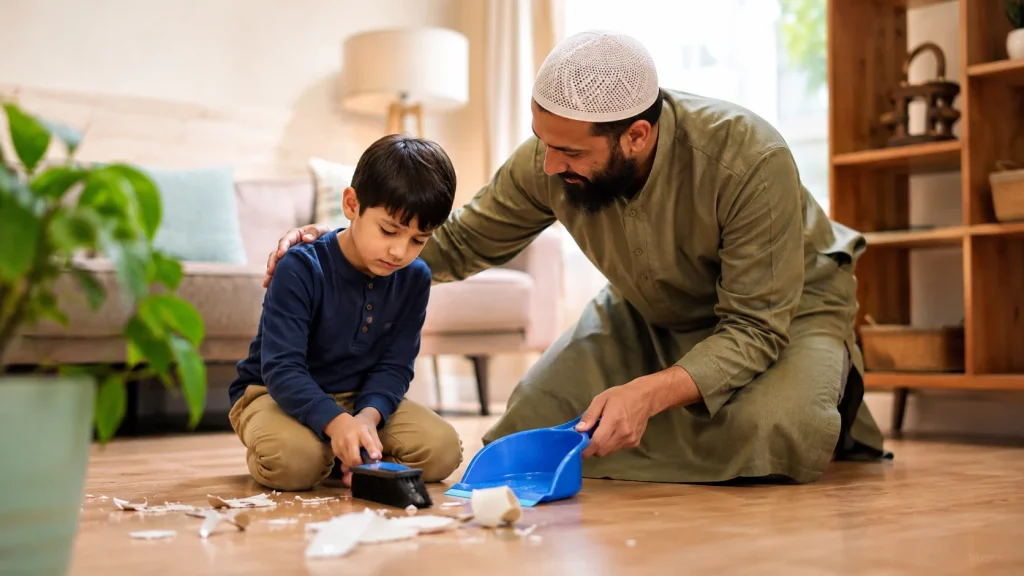
How to Explain “Saving from Hellfire” Nijat to Young Children
Quick Answer:
Teaching Nijat to kids means helping them understand that Allah Subhanahu wa Ta‘ala protects, forgives, guides, and saves. Parents should explain salvation from Hellfire with love, hope, and simple examples. The goal is not to frighten children, but to help them love Allah Subhanahu wa Ta‘ala, do good deeds, and ask for His mercy.
Featured Snippet Answer
Nijat means being saved and protected by Allah Subhanahu wa Ta‘ala from Hellfire and guided toward Jannah. When teaching Nijat to kids, begin with Allah’s mercy, use gentle language, teach simple duas, encourage good deeds, and avoid harsh descriptions of Jahannam that may scare young children.
On This Page
- What Does Nijat Mean in Islam?
- Why Children Should Learn Allah’s Mercy First
- The Qur’anic Foundation for Teaching Nijat
- How to Explain Jahannam Gently
- Good Deeds That Help Children Understand Nijat
- Simple Duas for Protection from Hellfire
- Prophet Yunus عليه السلام and the Meaning of Rescue
- Teaching Nijat in Ramadan and the Last 10 Days
- Age-by-Age Guide for Explaining Nijat
- Common Mistakes Parents Should Avoid
- How Qari for Kids Supports Your Child’s Qur’an Journey
- Conclusion
- FAQs
What Does Nijat Mean in Islam?
Nijat means rescue, safety, and protection.
In Islam, Nijat is not just about escaping punishment. It means Allah Subhanahu wa Ta‘ala saving a person from Hellfire, guiding them away from sin, forgiving their mistakes, and leading them toward Jannah.
For kids, keep Nijat simple.
You can say:
“Nijat means Allah Subhanahu wa Ta‘ala protects us and helps us reach Jannah.”
That one sentence is enough for a young child.
Children do not need a heavy theological lecture. They need a warm picture in their mind. Nijat is like a parent holding a child’s hand while crossing a busy road. It is like a light in a dark room. It is like someone warning you not to touch fire because they love you and want you safe.
This is the heart of teaching Nijat to kids.
We are not trying to make children afraid of Allah Subhanahu wa Ta‘ala. We are helping them feel safe with Him, close to Him, and hopeful in His mercy.
A child should grow up thinking:
“When I make a mistake, I can go back to Allah Subhanahu wa Ta‘ala.”
That belief is powerful. It protects the heart.
Why Children Should Learn Allah’s Mercy First
Teach Allah’s mercy before Jahannam.
This is not hiding truth; it is age-appropriate Islamic teaching.
Allah Subhanahu wa Ta‘ala says:
قُلْ يَـٰعِبَادِىَ ٱلَّذِينَ أَسْرَفُوا۟ عَلَىٰٓ أَنفُسِهِمْ لَا تَقْنَطُوا۟ مِن رَّحْمَةِ ٱللَّهِ ۚ إِنَّ ٱللَّهَ يَغْفِرُ ٱلذُّنُوبَ جَمِيعًا ۚ إِنَّهُۥ هُوَ ٱلْغَفُورُ ٱلرَّحِيمُ
“Do not lose hope in the mercy of Allah.”
(Surah Az-Zumar 39:53)
This verse should shape the way parents speak.
A young child understands emotion before deep belief. If Islam is always presented through fear, the child may obey for a while, but the heart may become distant. If Islam is presented through love, mercy, and gentle guidance, the child begins to trust Allah Subhanahu wa Ta‘ala.
That trust later becomes worship.
So begin with Allah’s names:
- Allah is Ar-Rahman, the Most Merciful.
- Allah is Al-Ghafoor, the Most Forgiving.
- Allah is Al-Lateef, the Most Gentle.
- Allah is Al-Hadi, the One who guides.
Then explain that Allah Subhanahu wa Ta‘ala warns us about Hellfire because He wants us to stay away from harm.
A parent warns a child about a hot stove. Not because the parent hates the child. Because the parent loves the child.
In the same way, Allah’s warnings are a mercy.
The Qur’anic Foundation for Teaching Nijat
One of the strongest verses for this topic is in Surah At-Tahrim (66:6):
يَـٰٓأَيُّهَا ٱلَّذِينَ ءَامَنُوا۟ قُوٓا۟ أَنفُسَكُمْ وَأَهْلِيكُمْ نَارًا
“O believers! Protect yourselves and your families from a Fire.”
This verse teaches parents that spiritual protection is a family responsibility.
Parents protect children from harm; they also protect their hearts.
How?
- By teaching salah.
- By teaching truthfulness.
- By teaching Qur’an.
- By teaching good manners.
- By teaching du‘a.
- By teaching repentance.
- By showing Islam through love at home.
In Islamic teaching, children often learn more from the atmosphere of a home than from one long lecture.
If a child sees parents praying calmly, asking Allah Subhanahu wa Ta‘ala for help, saying sorry after mistakes, giving charity, and speaking kindly, that child is already learning Nijat.
The lesson becomes visible.
This is where many parents miss the point. Nijat is not only a topic to explain. It is a life to model.
How to Explain Jahannam Gently
Jahannam is real. Muslims believe in it because Allah Subhanahu wa Ta‘ala tells us about it in the Qur’an.
But young children do not need frightening details.
A gentle explanation is enough:
“Jahannam is a place Allah Subhanahu wa Ta‘ala warned us about. He tells us about it so we stay away from bad choices and walk toward Jannah.”
That is clear. It is truthful. It is not harsh.
Avoid saying things like:
“Allah will throw you in Hell if you do that.”
This can damage a child’s understanding of Allah Subhanahu wa Ta‘ala. It can make them think Allah is angry all the time. It can also make Islam feel like a threat instead of guidance.
Instead, say:
“Allah Subhanahu wa Ta‘ala loves when we tell the truth. Let’s fix this mistake and ask Allah to help us.”
Or:
“Good choices bring us closer to Jannah.”
Or:
“When we make mistakes, we say sorry to Allah Subhanahu wa Ta‘ala and try again.”
The child learns accountability, but with hope.
Good Deeds That Help Children Understand Nijat
Children understand actions better than abstract words.
So connect salvation from Hellfire for kids to simple daily deeds.
The Prophet Muhammad ﷺ taught:
“Protect yourselves from the Fire, even with half a date; and whoever cannot find that, then with a good word.”
(Sahih al-Bukhari 6540; Sahih Muslim)
This is a beautiful teaching for children.
It means protection is not only through big actions. Small sincere deeds matter.
Tell your child:
“Every good deed is like a little light on the road to Jannah.”
Then give examples they can actually do:
- Say Bismillah before eating.
- Say Alhamdulillah after eating.
- Help parents without shouting.
- Share toys with siblings.
- Tell the truth even when it is hard.
- Say sorry after hurting someone.
- Put a coin in charity.
- Make du‘a before sleeping.
- Read a short surah every day.
- Speak kindly to friends.
This makes Nijat feel reachable.
A child begins to think:
“I can do good. Allah Subhanahu wa Ta‘ala sees me. Allah Subhanahu wa Ta‘ala loves when I try.”
That feeling builds iman.
Parents should also explain that good deeds are not a way to “buy” Jannah. We enter Jannah by Allah’s mercy, while good deeds show our faith, sincerity, and desire to please Allah Subhanahu wa Ta‘ala.
That balance is important.
Simple Duas for Protection from Hellfire
Children should not only hear about Nijat. They should learn how to ask for it.
One of the best duas is from Surah Al-Baqarah (2:201):
رَبَّنَآ ءَاتِنَا فِى ٱلدُّنْيَا حَسَنَةً وَفِى ٱلْـَٔاخِرَةِ حَسَنَةً وَقِنَا عَذَابَ ٱلنَّارِ
Meaning:
“Our Lord, give us good in this world and good in the Hereafter, and protect us from the punishment of the Fire.”
This dua is short, complete, and easy to repeat as a family.
You can teach it after salah, before sleep, or during Ramadan.
Another beautiful dua is:
رَبَّنَآ إِنَّنَآ ءَامَنَّا فَٱغْفِرْ لَنَا ذُنُوبَنَا وَقِنَا عَذَابَ ٱلنَّارِ
Meaning:
“Our Lord, we have believed, so forgive our sins and protect us from the punishment of the Fire.”
(Surah Aal ‘Imran 3:16)
For a young child, explain it like this:
“We are asking Allah Subhanahu wa Ta‘ala to forgive us and keep us safe.”
That is enough.
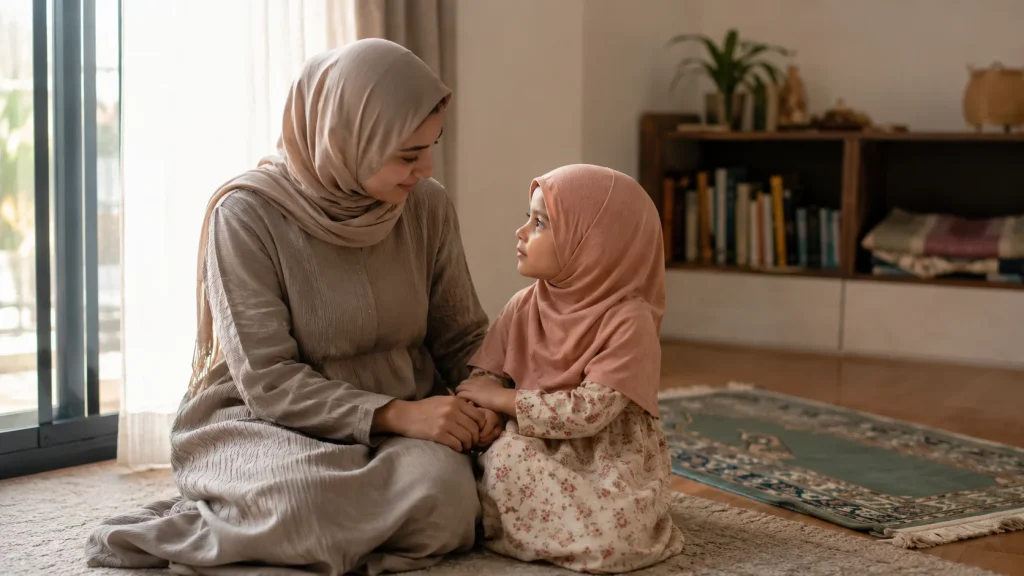
Parents can also create a small family routine. After Maghrib or before bedtime, everyone says one short dua together. No pressure. No long speech. Just a soft daily habit.
This is also a good time to teach dua for salvation in the last 10 days.
Prophet Yunus عليه السلام and the Meaning of Rescue
Children love stories. And the story of Prophet Yunus عليه السلام is one of the best stories for teaching Nijat.
Prophet Yunus عليه السلام left his people and later found himself in deep darkness: the darkness of the night, the darkness of the sea, and the darkness inside the whale.
But he called upon Allah Subhanahu wa Ta‘ala with a sincere heart:
لَّآ إِلَـٰهَ إِلَّآ أَنتَ سُبْحَـٰنَكَ إِنِّى كُنتُ مِنَ ٱلظَّـٰلِمِينَ
Meaning:
“There is no god except You. Glory be to You. Indeed, I was among the wrongdoers.”
(Surah Al-Anbiya 21:87)
Allah Subhanahu wa Ta‘ala accepted his dua and saved him.
For children, the lesson is simple:
Allah hears us everywhere.
Allah helps us when we are scared.
Allah loves when we say sorry.
Allah can bring us out of darkness.
No mistake is bigger than Allah’s mercy when we repent sincerely.
This teaches Nijat with hope.
It shows that rescue begins when the heart turns back to Allah Subhanahu wa Ta‘ala.
You can say:
“Prophet Yunus عليه السلام was saved because he remembered Allah Subhanahu wa Ta‘ala and asked for forgiveness. We should also remember Allah when we feel sad, scared, or sorry.”
That is a lesson a child can carry for life.
Teaching Nijat in Ramadan and the Last 10 Days
Ramadan is one of the best times to teach children about Nijat.
Why?
Because Ramadan already feels special. The house changes. The schedule changes. Parents make more dua. Families talk about forgiveness, Qur’an, charity, and Jannah.
The last 10 days of Ramadan are especially meaningful.
Still, keep it gentle.
You can tell your child:
“These nights are a special time to ask Allah Subhanahu wa Ta‘ala for forgiveness, Jannah, and protection from Jahannam.”
You can build a small routine:
- One short dua after iftar.
- One coin in charity.
- One page or short surah of Qur’an.
- One act of kindness at home.
- One apology if they hurt someone.
- One moment to ask Allah Subhanahu wa Ta‘ala for Jannah.
Parents can also use a simple “Nijat jar.” Each day, the child writes or draws one good deed and places it in the jar. By Eid, they see a month of small lights.
This connects Ramadan with action.
This is also a natural time to talk about seeking salvation on Laylatul Qadr. Children do not need a complicated explanation. Tell them:
“Laylatul Qadr is a very blessed night. We ask Allah Subhanahu wa Ta‘ala for forgiveness and Jannah.”
As Ramadan ends, parents can also balance worship with joy by completing the last Ashrah with Eid preparation. This helps children see Islam as both devotion and happiness.
Nijat should not feel heavy in a child’s heart. It should feel hopeful.
Age-by-Age Guide for Explaining Nijat
Every child is different, so use an age-based guide.
- Ages 3–5
Focus on love, Jannah, kindness, and Allah’s protection.
Say:
“Allah Subhanahu wa Ta‘ala loves good choices.”
“Allah Subhanahu wa Ta‘ala helps us.”
“Jannah is a beautiful place Allah gives to people who love Him.”
Avoid detailed descriptions of Jahannam.
- Ages 6–8
Introduce basic accountability.
Say:
“Some choices make Allah Subhanahu wa Ta‘ala happy, and some choices are wrong. When we make a mistake, we say sorry and try again.”
At this age, children can learn short duas and simple good deeds.
- Ages 9–12
You can explain Jahannam more clearly, but still without harsh images.
Say:
“Allah Subhanahu wa Ta‘ala tells us about Jahannam so we ask for protection and stay away from serious sins.”
Teach them about salah, honesty, respecting parents, and the rights of others.
- Teens
Teenagers can understand deeper topics: repentance, the Hereafter, accountability, peer pressure, private sins, and the mercy of Allah Subhanahu wa Ta‘ala.
Speak respectfully. Do not lecture all the time.
Teens need honest conversation. They also need to know that if they slip, the door of tawbah is open.
Common Mistakes Parents Should Avoid
- Using Hellfire as a Threat
This is a common parenting mistake.
When a parent says, “You will go to Jahannam if you do that,” the child may stop the action, but fear enters the heart in the wrong way.
Correction should guide, not crush.
Say:
“This action is not pleasing to Allah Subhanahu wa Ta‘ala. Let’s fix it.”
- Teaching Fear Without Hope
Fear has a place in Islam. But for children, hope should come first.
A child should know that Allah Subhanahu wa Ta‘ala forgives. Allah loves repentance. Allah rewards small deeds. Allah sees effort.
- Making Islam Sound Difficult
If every Islamic lesson sounds like pressure, children may quietly disconnect.
Keep Islamic learning warm. Use stories. Use examples. Use family habits. Use short duas.
- Forgetting Your Own Example
Children notice everything.
If parents speak about mercy but shout all the time, children become confused. If parents speak about salah but delay it without care, children notice.
Teaching Nijat starts with the home environment.
How Qari for Kids Supports Your Child’s Qur’an Journey
Children understand Islam better when they have a steady relationship with the Qur’an.
At Qari for Kids, children learn Qur’an with mercy, duas, manners, and age-appropriate guidance. Our online Qur’an classes are taught by certified male and female teachers, including teachers from Al Azhar University.
Children need patient teachers, repetition, encouragement, and wise Islamic guidance.
Whether your child is learning basic Qaida, Qur’an recitation, duas, salah, or Islamic manners, the right teacher can make the path easier.
Parents do their part at home. Teachers support that journey with knowledge and care.
Together, children can grow with love for the Qur’an, trust in Allah Subhanahu wa Ta‘ala, and hope for Jannah.
Conclusion: Nijat Begins with Turning Back to Allah
Nijat is not only a word about fear.
It is a word of hope.
It means Allah Subhanahu wa Ta‘ala protects us, guides us, forgives us, and saves us. It means we run away from sin by running toward Allah Subhanahu wa Ta‘ala. It means we teach our children that Jannah is real, Jahannam is real, and Allah’s mercy is greater than they can imagine.
When teaching Nijat to kids, begin with mercy, good deeds, duas, and age-appropriate accountability.
A child who loves Allah Subhanahu wa Ta‘ala will want to pray. A child who trusts Allah Subhanahu wa Ta‘ala will ask for forgiveness. A child who understands mercy will return after mistakes.
That is the real foundation of Nijat.
Give Your Child the Gift of the Quran This Ramadan
Start Online Quran Classes at Qari For Kids
1-on-1 certified tutors. Flexible scheduling around Ramadan hours. Free trial for families in USA, UK, Canada & Australia.
Give Your Child the Gift of the Quran This Ramadan
Start Online Quran Classes at Qari For Kids
1-on-1 certified tutors. Flexible scheduling around Ramadan hours. Free trial for families in USA, UK, Canada & Australia.
Featured Blogs
- Quran recitation for peace - A simple guide to calm the heart
- 10 Ways to teach kids about the mercy of ramadan
- What is Ramadan Mercy-Simple Stories for Kids
- The Path to Hifz – Quran Memorization Techniques and Rewards
- Seeking Forgiveness in Second Ashrah – Days of Maghfirah
- Second Ashrah Dua Ramadan – Days of Forgiveness
AUTHORED BY
Qari For Kids Editorial Team
Certified Quran & Arabic Educators
Our team of Ijazah-certified Qaris brings together over a decade of teaching Quran to children and adults across the USA, UK, Canada, and Australia.
- Ijazah-certified tutors
- 10,000+ students taught
- Reviewed by Islamic scholars
- Ijazah-certified tutors
Main Courses
Follow Us On:
Frequently Asked Questions
1. What does Nijat mean in Islam for kids?
Nijat means being saved and protected by Allah Subhanahu wa Ta‘ala. For children, you can explain it as Allah helping us stay away from bad choices, forgiving us when we repent, and guiding us toward Jannah.
2. How do I explain Jahannam to a young child?
Explain Jahannam gently. Say that it is a place Allah Subhanahu wa Ta‘ala warned us about so we stay away from bad choices and choose the path to Jannah. Avoid scary details, especially for very young children.
3. Should parents teach children about Hellfire?
Yes, but in an age-appropriate way. Young children should first learn Allah’s mercy, love, Jannah, and forgiveness. As they grow older, parents can explain accountability and Jahannam with more clarity.
4. What is the best dua for protection from Hellfire?
One of the best duas is:
رَبَّنَآ ءَاتِنَا فِى ٱلدُّنْيَا حَسَنَةً وَفِى ٱلْـَٔاخِرَةِ حَسَنَةً وَقِنَا عَذَابَ ٱلنَّارِ
It means asking Allah Subhanahu wa Ta‘ala for good in this world, good in the Hereafter, and protection from the punishment of the Fire.
5. How can children seek Nijat during Ramadan?
Children can make dua, give small charity, help parents, read Qur’an, say sorry for mistakes, and ask Allah Subhanahu wa Ta‘ala for Jannah and protection from Hellfire, especially during the last 10 days of Ramadan.
Explore Other Blogs
In this article, we will look closely at each pillar, explain what it means, share their Arabic names, and highlight guidance from the…
What Is Islam? The word “Islam†comes from the Arabic root S-L-M, which signifies peace, submission, and safety…
Written & Reviewed by Mufti Habib Ahmed Mufti Habib Ahmed is a Dars‑e‑Nizami graduate from Jamia Farooqia Karachi…