
Dua for Forgiveness for Kids: Teaching Children to Say "Astaghfirullah"
Added by : QFK Editorial Team
Published On : June 11, 2026
Islamic Date : 25 Dhul Hijjah 1447 AH
Last Updated : June 11, 2026
Added by : QFK Editorial Team
Published On : June 11, 2026
Islamic Date : 25 Dhul Hijjah 1447 AH
Last Updated : June 11, 2026
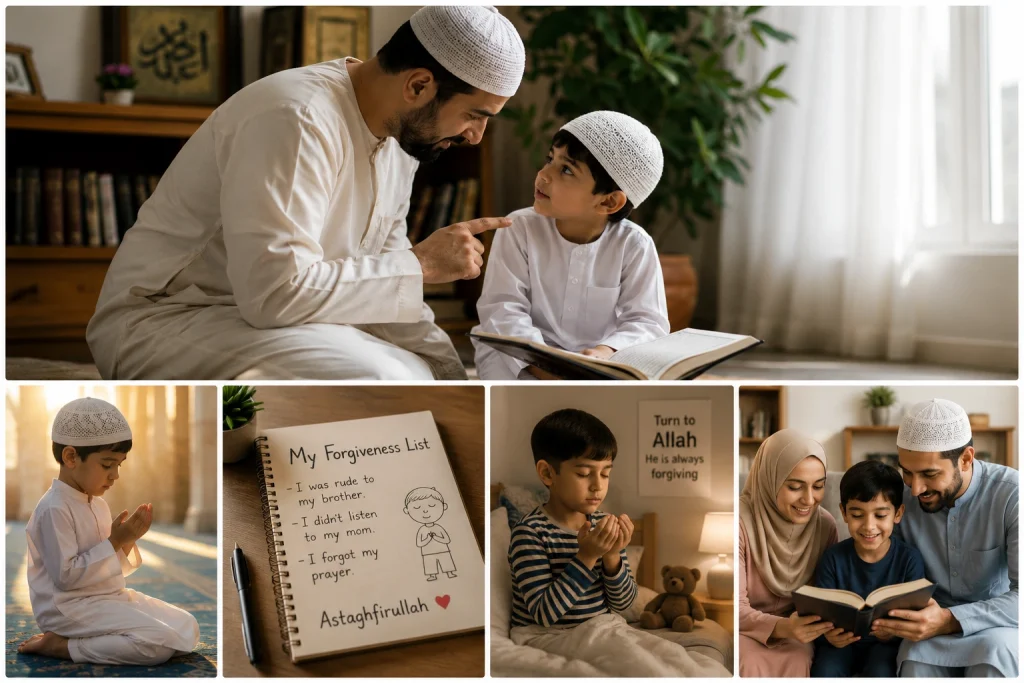
Dua for Forgiveness for Kids: Teaching Children to Say "Astaghfirullah"
The Best Dua for Forgiveness for Kids
The best dua for forgiveness for kids is “Astaghfirullah” (أستغفر الله), which means “I seek forgiveness from Allah.” This simple phrase teaches children that whenever they make a mistake, they can always turn back to Allah Subhanahu wa Ta’ala. Regular Istighfar helps children develop accountability, humility, and a lifelong habit of repentance.
This dua works well alongside our guide on teaching Nijat to kids gently.
To understand why this time of Ramadan matters so much, read Seeking Forgiveness in Second Ashrah – Days of Maghfirah.
For more duas to say together as a family, see our Second Ashrah Dua Ramadan – Days of Forgiveness.
On This Page
- A Small Parenting Moment That Can Shape a Child’s Faith
- What Is a Dua for Forgiveness for Kids?
- Astaghfirullah Meaning for a Child
- Why Every Child Should Learn Astaghfirullah
- Why Children Make Mistakes and Why That Is Normal
- Teaching Accountability Without Shame
- Quranic Foundations of Forgiveness
- Best Dua for Forgiveness for Kids
- Beautiful Forgiveness Duas from the Quran
- How to Teach Istighfar in Daily Life
- The Importance of Istighfar in the Second Ashrah
- Why Children Should Never Feel That Allah Will Not Forgive Them
- Benefits of Saying Astaghfirullah and Understanding Tawbah
- Learning Quran and Duas with Qualified Teachers
- Common Parenting Mistakes When Teaching Forgiveness
- Frequently Asked Questions
- Final Thoughts
A Small Parenting Moment That Can Shape a Child's Faith
A mother hears her young son say something hurtful to his sister during an argument.
A few minutes later, after emotions settle, she sits beside him and gently asks:
“Do you think that made Allah happy?”
The little boy lowers his head.
“No.”
Instead of shouting or making him feel ashamed, she places her hand on his shoulder and says:
“When we make mistakes, Allah gives us a beautiful way to come back to Him. Let’s say Astaghfirullah together.”
The boy repeats the words.
A few seconds later, the moment is over.
Or is it?
Years from now, he may forget the argument. He may forget why he was upset. But he may remember something much more important:
When I make a mistake, I can always return to Allah.
That is one of the greatest gifts a parent can give a child.
Every child will make mistakes. They will argue with siblings, disobey instructions, tell small lies, forget responsibilities, and sometimes act before thinking.
Islam does not teach us to expect perfection from children.
It teaches us to help them develop a relationship with Allah Subhanahu wa Ta’ala that remains strong even when they fall short.
Teaching children to say Astaghfirullah is not merely teaching a word. It is teaching a lifelong habit of repentance, humility, and hope.
What Is a Dua for Forgiveness for Kids?
A dua for forgiveness for kids is a supplication that helps children ask Allah Subhanahu wa Ta’ala for pardon after making mistakes.
Just as children learn to say “thank you” when receiving something good, they should also learn how to seek forgiveness when they do something wrong.
One of the simplest and most powerful forgiveness duas is:
أَسْتَغْفِرُ اللهَ
Astaghfirullah
Meaning:
“I seek forgiveness from Allah.”
Although the phrase is short, the lesson behind it is enormous.
When children regularly seek forgiveness, they begin learning:
- Accountability for their actions
- Humility instead of arrogance
- Respect for Allah’s commands
- Emotional self-control
- Hope in Allah’s mercy
Many parents focus heavily on correcting mistakes.
Islam goes a step further.
It teaches children what to do after the mistake.
That is where Istighfar becomes so powerful.
Astaghfirullah Meaning for a Child
Children understand examples better than definitions.
Instead of explaining complicated concepts, try saying:
“When we make a mistake, we ask Allah to forgive us and help us do better.”
For example:
- If a child hurts a sibling
- If they speak disrespectfully
- If they tell a lie
- If they forget a prayer
- If they disobey their parents
They can say:
“Astaghfirullah.”
This simple habit creates a connection between mistakes and repentance rather than guilt and hopelessness.
Over time, children begin understanding that mistakes do not define who they are.
What matters is how they respond afterward.
Why Every Child Should Learn Astaghfirullah
One of the greatest gifts parents can give their children is teaching them how to return to Allah Subhanahu wa Ta’ala.
Life will present many challenges.
Children will eventually become teenagers and adults. They will face temptations, disappointments, failures, and moments of weakness.
A child who learns Istighfar early develops a spiritual safety net.
Whenever they fall, they know where to turn.
Allah Subhanahu wa Ta’ala says:
“And Allah would not punish them while they seek forgiveness.”
(Quran 8:33)
This verse reminds us that seeking forgiveness is not merely about correcting mistakes. It is a source of mercy, protection, and spiritual growth.
Children who develop the habit of Istighfar often grow into adults who are more self-aware, reflective, and connected to their faith.
Stories stay longer than instructions
Why Children Make Mistakes and Why That Is Normal
Parents and Quran teachers often notice that children repeat the same mistakes while they are still learning self-control and responsibility.
A child promises not to lie but lies again.
A child apologizes for fighting with a sibling and repeats the behavior the next day.
A child knows they should pray but still forgets.
When these situations happen repeatedly, parents often wonder whether their lessons are working.
The reality is that children are still learning skills that adults take for granted.
They are learning:
- Self-control
- Patience
- Emotional regulation
- Decision-making
- Responsibility
Young children are naturally impulsive.
They often act before they think.
Sometimes they know something is wrong but struggle to stop themselves in the moment.
This is not necessarily a sign of bad character.
It is part of normal development.
Islam recognizes human weakness.
The Prophet Muhammad ﷺ said:
“Every son of Adam sins, and the best of those who sin are those who repent.”
(Sunan al-Tirmidhi)
Notice that the hadith does not say the best people never make mistakes.
It says the best people are those who repent.
This perspective can transform parenting.
Instead of measuring success by how few mistakes a child makes, we can measure success by how well they learn to return to Allah after making them.
Teaching Accountability Without Shame
One of the biggest challenges parents face is correcting behavior without damaging a child’s confidence.
There is an important difference between accountability and shame.
Accountability says:
“You made a mistake, but you can fix it.”
Shame says:
“You made a mistake because something is wrong with you.”
The first builds character.
The second damages it.
Imagine a child lies about finishing homework.
A shame-based response might sound like:
“Why do you always lie? I can’t trust you.”
An accountability-based response sounds different:
“Lying is wrong, but telling the truth is always better. Let’s fix this together and ask Allah for forgiveness.”
The behavior is corrected, but the child’s dignity remains intact.
This simple approach makes talking to kids about forgiveness easier and more effective.
Allah Subhanahu wa Ta’ala repeatedly calls people toward repentance.
He does not tell believers that their mistakes make them worthless.
Instead, He reminds them that His mercy remains available.
Children should learn:
- Mistakes do not define them.
- Allah loves sincere repentance.
- Seeking forgiveness is a strength, not a weakness.
- Every Astaghfirullah is a new opportunity to improve.
When children understand this, they become more willing to admit mistakes instead of hiding them.
That honesty is one of the foundations of strong Islamic character.
Many children hide mistakes because they fear punishment, not because they do not understand right and wrong.
When children feel safe admitting mistakes, parents gain more opportunities to teach sincere repentance, responsibility, and honesty.
A child who confesses a mistake is often showing courage. That moment should be used to teach and guide rather than simply punish.
The goal is not to raise children who never make mistakes. The goal is to raise children who are honest enough to admit them and humble enough to seek Allah’s forgiveness afterward.
Quranic Foundations of Forgiveness
Forgiveness is one of the most repeated themes in the Quran.
Allah Subhanahu wa Ta’ala describes Himself as:
الغفور الرحيم
“The Most Forgiving, The Most Merciful.”
One of the most beautiful verses about repentance is:
إِنَّ اللَّهَ يُحِبُّ التَّوَّابِينَ وَيُحِبُّ الْمُتَطَهِّرِينَ
“Indeed, Allah loves those who repent and loves those who purify themselves.”
(Quran 2:222)
Notice something remarkable.
Allah does not say He loves those who never make mistakes.
He says He loves those who repent.
That message is especially important for children.
Many children become discouraged after making mistakes.
They think:
- “I am bad.”
- “I keep messing up.”
- “Allah must be disappointed with me.”
The Quran teaches the opposite.
Allah loves those who keep returning to Him.
The Prophet Muhammad ﷺ demonstrated this perfectly.
Despite being free from sin, he sought forgiveness constantly.
He said:
“By Allah, I seek Allah’s forgiveness and repent to Him more than seventy times a day.”
(Sahih al-Bukhari)
If the Prophet Muhammad ﷺ made Istighfar regularly, then seeking forgiveness is not only for people who commit major sins.
It is a daily act of worship that keeps the heart connected to Allah.
For parents, this is a powerful lesson.
If the best human being constantly sought forgiveness, then our children should learn that repentance is a normal and beautiful part of being a Muslim.
Best Dua for Forgiveness for Kids
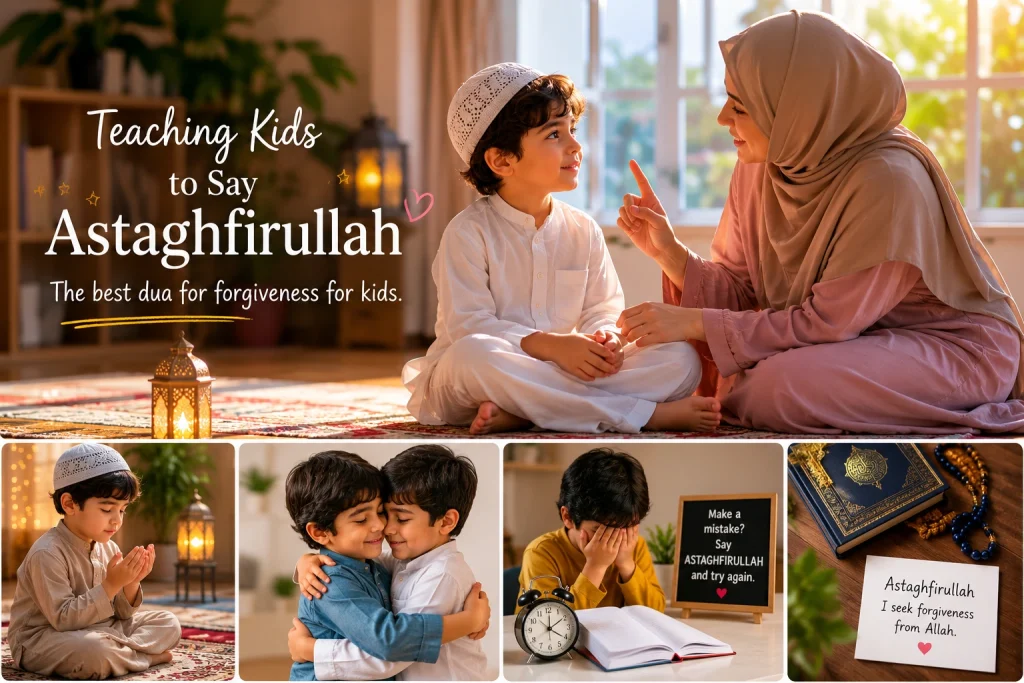
The best forgiveness duas for children are simple, meaningful, and easy to remember.
Start with shorter duas before introducing longer supplications.
1- Astaghfirullah
Arabic:
أَسْتَغْفِرُ اللهَ
Transliteration:
Astaghfirullah
Meaning:
“I seek forgiveness from Allah.”
This is the easiest forgiveness dua for children and can be used throughout the day.
2- Simple Forgiveness Dua
Arabic:
أَسْتَغْفِرُ اللهَ رَبِّي مِنْ كُلِّ ذَنْبٍ وَأَتُوبُ إِلَيْهِ
Transliteration:
Astaghfirullaha Rabbi min kulli dhanbin wa atubu ilayh.
Meaning:
“I seek forgiveness from Allah, my Lord, for all my sins, and I turn to Him in repentance.”
Encourage children to recite this:
- After Salah
- Before sleeping
- After arguments
- After mistakes
- During Ramadan
3- Sayyidul Istighfar – The Best Dua for Forgiveness
The Prophet Muhammad ﷺ described Sayyidul Istighfar as the master supplication for forgiveness.
He said that whoever recites it sincerely during the day and dies before evening, or recites it at night and dies before morning, will be among the people of Paradise.
(Sahih al-Bukhari 6306)
اللَّهُمَّ أَنْتَ رَبِّي، لاَ إِلَهَ إِلاَّ أَنْتَ، خَلَقْتَنِي وَأَنَا عَبْدُكَ…
For older children, parents can gradually teach the complete Sayyidul Istighfar along with its meaning.
Meaning:
“O Allah, You are my Lord. There is no god except You. You created me, and I am Your servant…”
For younger children, begin by teaching the meaning before expecting memorization.
When children understand why a dua matters, they are far more likely to remember and love it.
How to Teach Istighfar in Daily Life
Teaching children Istighfar is not something that happens in a single lesson.
It happens through small moments repeated over time.
Children learn best through daily experiences.
The goal is to make Astaghfirullah a natural part of family life.
1- When a Child Lies
Every parent eventually faces this situation.
A child breaks something and denies it.
A child says homework is finished when it is not.
The instinctive reaction is often frustration.
Instead, try turning the moment into a lesson.
- Help your child admit the truth.
- Explain why honesty matters.
- Then encourage them to say:
“Astaghfirullah.”
This teaches that mistakes should lead to repentance rather than hiding.
2- When Siblings Fight
Arguments between siblings are normal.
After helping both children calm down, encourage them to apologize to one another and seek forgiveness from Allah.
This teaches them that repairing relationships is part of faith.
3- When a Child Misses Salah
Many children forget prayers while they are learning.
Avoid making the mistake about shame.
Instead:
- Remind them gently.
- Help them pray.
- Encourage Istighfar.
- Praise their effort to improve.
Children respond much better to encouragement than humiliation.
4- Before Sleeping
A bedtime Istighfar routine can become one of the most meaningful habits in a child’s life.
Before sleeping, encourage children to think about their day.
Ask:
- Did I hurt anyone today?
- Did I obey my parents?
- Did I remember Allah?
Then recite Astaghfirullah together.
This helps children develop self-reflection from an early age.
5- After Every Salah
The Prophet Muhammad ﷺ would seek forgiveness after prayer.
A simple family habit is saying:
Astaghfirullah
Astaghfirullah
Astaghfirullah
after every Salah.
Small habits repeated consistently often become lifelong acts of worship.
The Importance of Istighfar in the Second Ashrah
Muslims often refer to Ramadan as having three Ashrahs (ten-day periods), with the second Ashrah commonly associated with seeking Allah’s forgiveness.
The second ten days focus on Maghfirah, or forgiveness.
This period provides a wonderful opportunity to teach children about Allah’s mercy.
During these days, families can:
- Increase Astaghfirullah.
- Memorize forgiveness duas.
- Discuss mistakes and repentance.
- Encourage personal reflection.
Many parents focus heavily on fasting and prayer during Ramadan.
The second Ashrah reminds us to focus on something equally important:
Returning to Allah Subhanahu wa Ta’ala with sincere hearts.
This is also a perfect opportunity to discuss the importance of istighfar in the second Ashrah and help children understand why forgiveness plays such a central role in Ramadan.
One lesson children should learn during these blessed days is that Allah’s mercy remains available no matter how many mistakes a person has made.
Why Children Should Never Feel That Allah Will Not Forgive Them
Perhaps the most important lesson in this entire article is this:
Children should never believe their mistakes are bigger than Allah’s mercy.
Sometimes children become discouraged.
- They make the same mistake repeatedly.
- They lose their temper again.
- They forget a prayer again.
- They tell another lie.
Eventually they begin to think:
- “Maybe Allah is angry with me.”
- “Maybe Allah won’t forgive me.”
Parents should address these thoughts immediately.
Allah Subhanahu wa Ta’ala says:
“Do not despair of the mercy of Allah. Indeed, Allah forgives all sins.”
(Quran 39:53)
This verse is one of the most hopeful verses in the entire Quran.
It teaches that no matter how many mistakes a person makes, the door of repentance remains open.
The story of Prophet Adam عليه السلام teaches the same lesson.
After making a mistake, he did not run away from Allah.
He returned to Allah.
And Allah accepted his repentance.
This story shows children that mistakes are not the end of the journey.
Sometimes they are the beginning of a stronger relationship with Allah.
Parents should remind children:
- Allah loves sincere repentance.
- Allah loves honesty.
- Allah loves effort.
- Allah loves those who return to Him.
Even if a child struggles with the same habit repeatedly, they should never stop making Istighfar.
Every sincere Astaghfirullah brings them closer to Allah Subhanahu wa Ta’ala.
One of the most powerful beliefs a child can grow up with is:
“My mistakes are never bigger than Allah’s mercy.”
That belief can protect their faith for a lifetime.
Benefits of Saying Astaghfirullah and Understanding Tawbah
Many people think Istighfar only removes sins.
In reality, it brings countless blessings.
1- It Strengthens a Child’s Relationship with Allah
When children regularly seek forgiveness, they learn that Allah is always near.
This creates a stronger spiritual connection.
2- It Builds Self-Awareness
Children begin noticing their actions more carefully.
They become more thoughtful before speaking or acting.
3- It Encourages Good Character
A child who regularly reflects on mistakes often develops greater honesty, patience, and kindness.
4- It Brings Peace of Mind
Seeking forgiveness helps remove feelings of guilt and replaces them with hope.
5- It Teaches the Meaning of Tawbah
Parents do not need complicated explanations.
Children can understand Tawbah through five simple steps:
- Admit the mistake.
- Feel sorry for it.
- Stop doing it.
- Try not to repeat it.
- Make things right if someone was hurt.
For example:
If a child insults a sibling:
- They admit it.
- Feel regret.
- Stop the behavior.
- Try not to repeat it.
- Apologize.
This is Tawbah in a way children can understand.
Can Small Mistakes Become Bigger Problems?
Yes, they can.
Not because the mistake itself is always huge, but because repeated mistakes without repentance can slowly harden the heart.
A child who lies once and feels sorry is learning.
A child who lies again and says Astaghfirullah is still trying.
But a child who lies, hides it, laughs about it, and feels no regret needs gentle guidance before the habit becomes normal.
This is why regular Istighfar is so important.
It keeps the heart soft. It reminds children that Allah Subhanahu wa Ta’ala sees them, loves sincere repentance, and gives them another chance to do better.
Rather than making children afraid of every mistake, parents should teach them to fear becoming comfortable with mistakes.
That is the real danger.
A child who still says Astaghfirullah with a sincere heart has not failed. That child is still connected to Allah Subhanahu wa Ta’ala.
Learning Quran and Duas with Qualified Teachers
Many parents successfully teach children what to say. The bigger challenge is helping them understand why they are saying it.
Teaching a child to say Astaghfirullah once is easy.
Helping them understand its meaning, remember it consistently, and make it part of their daily life is much more challenging.
This is where structured Islamic education can make a lasting difference.
Children learn best when they regularly hear Islamic reminders, practice duas with guidance, and interact with positive role models who encourage good character.
As parents, we do our best to teach these lessons at home. However, children often benefit from hearing the same message from trusted teachers who reinforce what they learn from their families.
At Qari for Kids, students learn Quran, daily duas, Tajweed, Islamic manners, and essential acts of worship from qualified male and female teachers, including graduates of Al-Azhar University.
More importantly, children learn the meaning behind what they recite.
Instead of simply memorizing words, they understand:
- Why Muslims seek forgiveness.
- Why honesty matters.
- Why repentance is a sign of strength.
- How to build a relationship with Allah Subhanahu wa Ta’ala.
When children understand the purpose behind Astaghfirullah, it becomes much more than a phrase. It becomes part of their identity as young Muslims.
For many parents, having knowledgeable teachers support their child’s Islamic development provides consistency, encouragement, and guidance that can benefit them for years to come.
Common Parenting Mistakes When Teaching Forgiveness
Teaching forgiveness is not only about what we teach.
It is also about how we teach it.
Sometimes well-meaning parents accidentally make forgiveness feel frightening or discouraging.
Here are some common mistakes to avoid.
1- Using Fear More Than Hope
Children should know that Allah Subhanahu wa Ta’ala dislikes sin.
However, they should also know that He is Ar-Rahman and Ar-Raheem.
If children only hear about punishment, they may begin associating Islam with fear.
If they learn about Allah’s mercy alongside accountability, they develop a healthier and more balanced relationship with faith.
2- Expecting Perfection
Children are learning.
- They will repeat mistakes.
- They will forget lessons.
- They will need reminders.
This does not mean your efforts are failing.
Character development takes time.
Focus on progress rather than perfection.
3- Publicly Embarrassing Children
Correcting a child in front of others can sometimes create shame rather than learning.
Whenever possible, address mistakes privately and respectfully.
Children are more receptive when they feel safe.
4- Teaching Arabic Without Meaning
Many children memorize duas without understanding them.
While memorization is valuable, understanding creates connection.
Take time to explain what Astaghfirullah means and why seeking forgiveness matters.
Even a simple explanation can make a profound difference.
5- Forgetting to Model Istighfar Yourself
Children notice far more than we realize.
If they hear their parents saying Astaghfirullah after mistakes, they learn that repentance is a normal part of being a Muslim.
Often the most powerful lessons are the ones we demonstrate rather than teach.
Final Thoughts
Every child will make mistakes.
They will argue with siblings, forget responsibilities, lose their temper, and sometimes make choices they regret.
That is not a sign of failure.
It is part of being human.
As parents, our goal is not to raise children who never make mistakes.
That standard is impossible.
Our goal is something far more valuable.
We want to raise children who know exactly where to turn when they do make mistakes.
When a child learns to say Astaghfirullah with sincerity, understands that Allah Subhanahu wa Ta’ala is Al-Ghafur, and develops the habit of repentance, they gain a gift that can benefit them for the rest of their lives.
Long after childhood, long after our reminders and advice, that habit can continue guiding them back to Allah through every challenge, every setback, and every stage of life.
The Prophet Muhammad ﷺ sought forgiveness every day despite being the best of creation.
What a beautiful example for us and our children.
Teach your child Astaghfirullah.
Help them understand its meaning.
Show them that Allah’s mercy is always greater than their mistakes.
Because the goal is not to raise children who never fall.
The goal is to raise children who always know how to return to Allah Subhanahu wa Ta’ala when they do.
And perhaps that is one of the greatest gifts a parent can leave behind.
Every Astaghfirullah today can become a habit that protects a child’s faith tomorrow.
Give Your Child the Gift of the Quran This Ramadan
Start Online Quran Classes at Qari For Kids
1-on-1 certified tutors. Flexible scheduling around Ramadan hours. Free trial for families in USA, UK, Canada & Australia.
Give Your Child the Gift of the Quran This Ramadan
Start Online Quran Classes at Qari For Kids
1-on-1 certified tutors. Flexible scheduling around Ramadan hours. Free trial for families in USA, UK, Canada & Australia.
Featured Blogs
- Quran recitation for peace - A simple guide to calm the heart
- 10 Ways to teach kids about the mercy of ramadan
- What is Ramadan Mercy-Simple Stories for Kids
- The Path to Hifz – Quran Memorization Techniques and Rewards
- Seeking Forgiveness in Second Ashrah – Days of Maghfirah
- Second Ashrah Dua Ramadan – Days of Forgiveness
AUTHORED BY
Qari For Kids Editorial Team
Certified Quran & Arabic Educators
Our team of Ijazah-certified Qaris brings together over a decade of teaching Quran to children and adults across the USA, UK, Canada, and Australia.
- Ijazah-certified tutors
- 10,000+ students taught
- Reviewed by Islamic scholars
- Ijazah-certified tutors
Main Courses
Follow Us On:
Frequently Asked Questions
What is the best dua for forgiveness for kids?
The simplest and most effective dua is:
أَسْتَغْفِرُ اللهَ
(Astaghfirullah)
It means:
“I seek forgiveness from Allah.”
Because it is short and easy to remember, it is often the first forgiveness dua parents teach their children.
At What Age Should Children Learn Istighfar?
Children can begin learning Astaghfirullah as soon as they start speaking simple words.
Many parents introduce it between the ages of two and four.
The earlier children hear it in daily life, the more naturally it becomes part of their vocabulary.
How Many Times Should a Child Say Astaghfirullah?
There is no fixed number.
Some families encourage children to say it three times after Salah.
Others create a habit of saying it before sleep.
The goal is consistency rather than counting.
Is Sayyidul Istighfar Suitable for Children?
Yes.
Younger children may need time to memorize it because it is longer than other duas.
A helpful approach is to teach the meaning first and gradually introduce the Arabic text.
Understanding often makes memorization easier.
Why Is the Second Ashrah Important?
The second Ashrah of Ramadan focuses on Maghfirah (forgiveness).
It reminds Muslims to increase Istighfar, seek Allah’s mercy, and reflect on their actions.
For parents, it is also an excellent opportunity to teach children about repentance and forgiveness.
Does Allah Forgive Children for Mistakes?
Allah Subhanahu wa Ta’ala is Al-Ghafur (The Most Forgiving) and Ar-Raheem (The Most Merciful).
Children who sincerely seek forgiveness and try to improve should never lose hope in Allah’s mercy.
One of the most important lessons we can teach is that Allah loves those who return to Him.
Explore Other Blogs
In this article, we will look closely at each pillar, explain what it means, share their Arabic names, and highlight guidance from the…

What Is Islam? The word “Islam†comes from the Arabic root S-L-M, which signifies peace, submission, and safety…
Written & Reviewed by Mufti Habib Ahmed Mufti Habib Ahmed is a Dars‑e‑Nizami graduate from Jamia Farooqia Karachi…