
Tajweed for Kids: A Simple Guide for Parents to Teach at Home
Added by : QFK Editorial Team
Published On : April 29, 2026
Islamic Date : 11 Dhul Qa'dah 1447 AH
Last Updated : April 29, 2026
Added by : QFK Editorial Team
Published On : April 29, 2026
Islamic Date : 11 Dhul Qa'dah 1447 AH
Last Updated : April 29, 2026

Quick Summary
Tajweed for kids means teaching children to read the Quran correctly by giving every letter its proper sound. It is best learned step by step through listening, practice, and patience. Parents do not need to be experts – simple daily habits and a supportive environment make the biggest difference.
What is Tajweed for Kids? (Quick Answer)
Tajweed for kids is the method of teaching children to recite the Quran correctly by giving each letter its proper pronunciation. It focuses on sound accuracy, listening, and gradual learning so children develop correct recitation habits from an early age.
For a deeper breakdown of the rules themselves, see Learn Quran Recitation: A Guide to Tajweed Rules.
Correct Tajweed also supports memorization – read The Path to Hifz – Quran Memorization Techniques and Rewards.
Beyond accuracy, recitation brings real peace to the heart – see Quran Recitation for Peace.
1. Introduction: What is Tajweed & Why It Matters
Tajweed simply means giving every letter its right.
Not just reading. Not just finishing quickly. But reading the Quran the way it was revealed. Allah Subhanahu Wa Ta’ala says:
“And recite the Qur’an with measured recitation.” (Surah Al-Muzzammil 73:4)
For children, Tajweed is not about perfection. It is about starting right.
A child who learns correct sounds early will not struggle later.
A child who ignores Tajweed early often spends years fixing mistakes.
If you are just starting, focus first on understanding Tajweed rules in a simple way instead of trying to memorize everything at once.
Simple example:
“لُق) “Qul) | means “Say” |
“كلُ) ” Kul) | means “Eat” |
A small change in sound, but a completely different meaning.
Imagine – one small mistake can change Allah Subhanahu Wa Ta’ala’s command from “Say” to “Eat.” That is why Tajweed matters.
Want your child to start Tajweed the right way from the beginning? • Book a Free Trial Class • Learn with certified male and female teachers • One-on-one attention for proper pronunciation |
2. When Should a Child Start Tajweed?
Start earlier than you think – but keep it light.
- Ages 3-5 -> Listening and sound familiarity
- Ages 5-7 -> Basic structured learning
At a young age, children do not need rules.
They need ears before books.
Let them hear Quran daily.
Let them repeat slowly.
Early exposure builds natural fluency.
But if your child is older, don’t worry.
A late start is still a strong start.
3. Can Kids Learn Quran Without Tajweed First?
Yes. But there is a risk.
A child can learn to read without Tajweed.
But incorrect sounds become habits.
And habits are hard to fix.
Start reading.
Add Tajweed slowly.
Not heavy rules. Just correct sound from the beginning.
4. Tajweed vs Regular Arabic Reading
Tajweed | Regular Reading |
Focus on correct pronunciation | Focus on basic reading |
Uses makharij and rules | Often ignores sound depth |
Preserves Quran recitation | May change meanings |
Slower but accurate | Faster but incomplete |
A child may read fluently, but still read incorrectly.
That is the difference.
5. Why Some Children Learn Tajweed Faster
Many parents think:
“My child is slow.”
“Other kids are smarter.”
That is not always true.
Most of the time, the difference is:
- Environment
- Exposure
- Routine
- Confidence
A child who hears Quran daily will sound better naturally.
A child who practices once a week will struggle.
Key insight: Fast learners are often just more exposed – not more gifted.
6. Learning Differences: Asian vs Other Children
Children with a strong Quran environment
- Quran is played daily
- Family corrects naturally
- Arabic sounds feel familiar
Children in different environments
- Less exposure
- Busy school routines
- Arabic sounds feel new
This is not a disadvantage.
It just means your child needs more listening and repetition.
Not more pressure.
7. Language Barriers & Pronunciation Challenges
Some sounds are hard.
Because some languages simply do not have them.
Examples:
ع •
ح •
ق •
ش •
So when a child struggles, it is not laziness.
It is a language difference.
Why are these sounds difficult?
These sounds come from deeper parts of the throat and mouth, which are not used in English and many other languages.
That is why children feel uncomfortable at first.
What helps:
- Listening daily
- Watching mouth movement
- Practicing one sound at a time
Never shame a child for their accent.
Correct gently. Repeat often.
8. Are Children Sinful for Incorrect Pronunciation?
This is very important.
Children are learning.
They are not held accountable like adults.
The Prophet Muhammad صلى الله عليه وسلم said:
“The best of you are those who learn the Qur’an and teach it.” (Sahih Bukhari)
Learning itself is rewarded.
Effort matters.
Struggle matters.
Key message for parents: Teach with mercy, not fear.
9. Understanding Tajweed Levels
Tajweed is not one step.
It builds slowly.
Level 1
- Letters
- Basic sounds
Level 2
- Madd
- Qalqalah
- Heavy and light letters
Level 3
- Flow
- Rhythm
- Advanced rules
Do not rush.
Children do not need everything at once.
10. Teaching Tajweed to Kids (Ages 3-7)
Keep it simple.
- 5-10 minutes daily
- One sound at a time
- Repeat gently
- Praise effort
Avoid:
- Long lectures
- Too many rules
- Constant correction
Build love first.
Then improve technique.
11. Daily Practice, Listening & Retention Tips
This is where most parents go wrong.
They focus on teaching, but ignore listening.
Listening is powerful.
A strong routine becomes easier when you start integrating Tajweed into home lessons in small, consistent steps.
(used Anchor Text “integrating Tajweed into home lessons”)
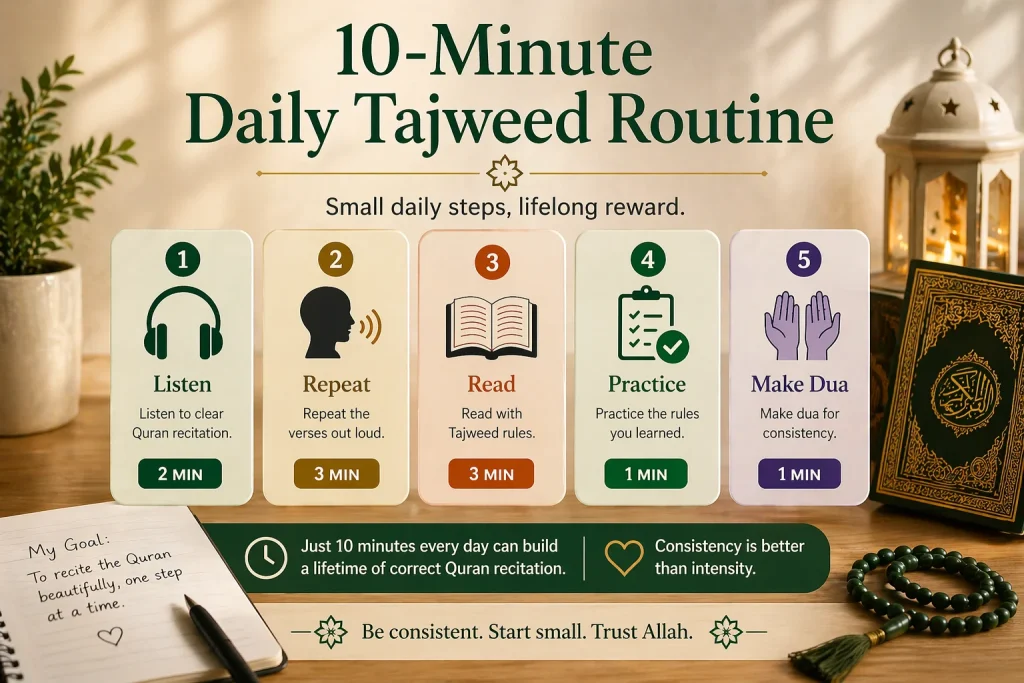
Simple routine:
- Play Quran daily
- Child repeats after reciter
- Keep the same time every day
Consistency beats intensity.
10 minutes daily is better than 1 hour randomly.
Struggling to stay consistent with your child’s Quran practice? • Get structured Tajweed lessons at home • Flexible timings for busy families • Step-by-step guidance for kids |
12. Common Mistakes & Fixes
Mistake | Fix |
Reading too fast | Slow down |
Ignoring makharij | Focus on one letter |
Over-correction | Reduce pressure |
Memorizing wrong | Correct early |
Golden rule: Fix one mistake at a time.
13. Making Tajweed Easy, Fun & Effective
Children learn better when they enjoy it.
- Keep sessions light
- Celebrate small progress
- Avoid fear-based teaching
But here is the reality:
Some corrections need a trained ear.
Parents can guide.
But teachers refine.
That is where structured learning helps.
If your child struggles with pronunciation or consistency, having a qualified teacher can make things much easier.
If you want your child to learn Tajweed correctly with expert guidance: • Start a Free Trial Class Today • Certified teachers trained in proper Tajweed • Personalized attention for every child |
Give Your Child the Gift of the Quran This Ramadan
Start Online Quran Classes at Qari For Kids
1-on-1 certified tutors. Flexible scheduling around Ramadan hours. Free trial for families in USA, UK, Canada & Australia.
Give Your Child the Gift of the Quran This Ramadan
Start Online Quran Classes at Qari For Kids
1-on-1 certified tutors. Flexible scheduling around Ramadan hours. Free trial for families in USA, UK, Canada & Australia.
Conclusion
Tajweed for kids is not about strict rules.
It is about:
- Building correct sound
- Creating love for the Quran
- Guiding with patience
Some children learn fast.
Some take time.
Both are okay.
What matters is consistency.
What matters is effort.
And what matters most is that the child grows with a connection to the Quran – reading it correctly, slowly, and with love.
Featured Blogs
- Quran recitation for peace - A simple guide to calm the heart
- 10 Ways to teach kids about the mercy of ramadan
- What is Ramadan Mercy-Simple Stories for Kids
- The Path to Hifz – Quran Memorization Techniques and Rewards
- Seeking Forgiveness in Second Ashrah – Days of Maghfirah
- Second Ashrah Dua Ramadan – Days of Forgiveness
AUTHORED BY
Qari For Kids Editorial Team
Certified Quran & Arabic Educators
Our team of Ijazah-certified Qaris brings together over a decade of teaching Quran to children and adults across the USA, UK, Canada, and Australia.
- Ijazah-certified tutors
- 10,000+ students taught
- Reviewed by Islamic scholars
- Ijazah-certified tutors
Main Courses
Follow Us On:
Frequently Asked Questions
What is the best age to start Tajweed?
Around 4-7 is ideal, but listening can start earlier.
Can I teach Tajweed at home?
Yes. Start with basics and support with a teacher when needed.
What if my child has an accent?
That is normal. Practice and listening improve it over time.
Is Noorani Qaida enough?
It is a strong starting point, but Tajweed must follow.
Should my child memorize before Tajweed?
It is better to improve pronunciation alongside memorization.
How long does it take to improve?
With daily practice, progress can be seen in weeks.
Editorial Note: The views and guidance in this article are drawn from established Islamic scholarly tradition and are intended for general educational purposes. Individual circumstances vary — for specific fiqh questions about fasting for children or those with health conditions, please consult a qualified Islamic scholar. Qari For Kids is an educational platform and does not issue religious rulings.
Explore Other Blogs
In this article, we will look closely at each pillar, explain what it means, share their Arabic names, and highlight guidance from the…

What Is Islam? The word “Islam†comes from the Arabic root S-L-M, which signifies peace, submission, and safety…

Written & Reviewed by Mufti Habib Ahmed Mufti Habib Ahmed is a Dars‑e‑Nizami graduate from Jamia Farooqia Karachi…